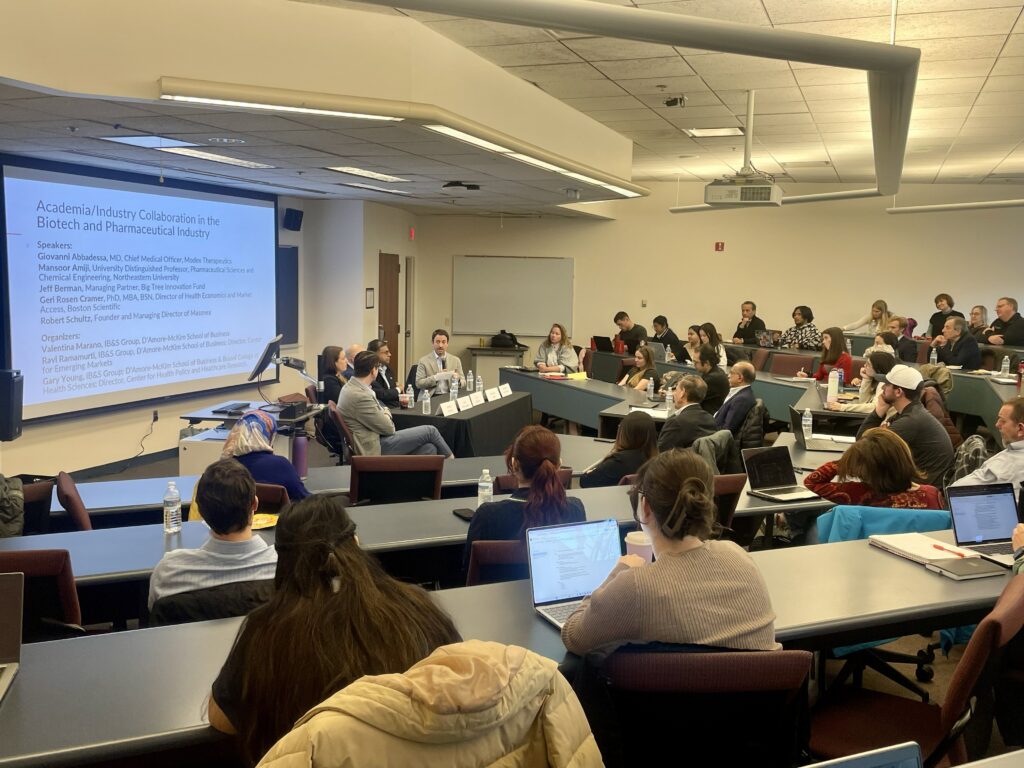
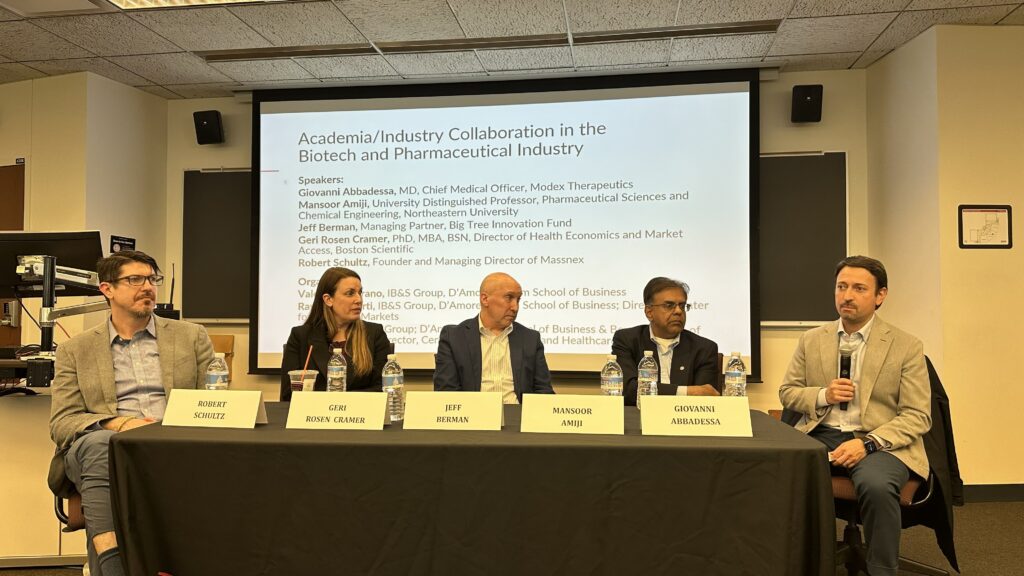
On Tuesday, April 7, 2026, D'Amore-McKim School of Business professors Valentina Marano, Ravi Ramamurti, and Gary Young convened academic and industry leaders for an informal panel discussion on the partnership models driving innovation across the global life-sciences ecosystem. Co-sponsored by the Center for Emerging Markets, the Center for Health Policy and Healthcare Research, and the D'Amore-McKim School of Business, the event brought together experts from biotechnology, pharmaceuticals, venture capital, medical technology, and academia to explore how universities and industry partners could collaborate more effectively in a rapidly changing global environment.
The panel featured Giovanni Abbadessa, MD, Chief Medical Officer of Modex Therapeutics; Mansoor Amiji, University Distinguished Professor of Pharmaceutical Sciences and Chemical Engineering at Northeastern University; Jeff Berman, Managing Partner of Big Tree Innovation Fund; Geri Rosen Cramer, PhD, MBA, BSN, Director of Health Economics and Market Access at Boston Scientific; and Robert Schultz, Founder and Managing Director of Massnex.
Panelists discussed the current funding climate in biotech and pharma, noting that early-stage capital has become more risk-averse even as established investors remain active. They emphasized that translating scientific discovery into a fundable venture requires more than strong science alone. Founders must demonstrate proof of concept, understand the market for their innovation, and communicate a compelling economic value proposition to investors and potential partners. Speakers also highlighted the importance of engaging multiple stakeholders early, including investors, patient advocates, academic collaborators, and government actors. The discussion further underscored the value of incorporating health economics expertise into the development process so that scientific innovation could be aligned with reimbursement realities and commercial viability.
The conversation then turned to collaboration models between academia and industry. Panelists noted that these partnerships often hold enormous promise but also face practical barriers, including protracted negotiations over intellectual property, publication rights, overhead costs, and institutional bureaucracy. While contract research organizations were described as efficient implementation partners for certain types of outsourced research and development work, speakers stressed that academic institutions play a distinct and indispensable role in generating new knowledge. The discussion suggested that universities could strengthen their role in the innovation ecosystem by developing more nimble structures and incentives that make collaboration easier and faster.
A major theme of the event was the changing geography of life-sciences innovation. Although Boston was still described as a world-leading cluster, panelists noted that its long-term strength could not be taken for granted. They pointed to the central role of government support in sustaining drug development ecosystems and warned that reduced public investment could weaken local innovation capacity. China was identified as increasingly important rival for innovation, benefiting from government support, sustained investment, STEM talent, and flexible regulation. India was seen as a strong player in generics and low-cost manufacturing but not yet in new drug development.
In closing, Ravi Ramamurti reflected on how innovation clusters emerge, strengthen, and sometimes decline, emphasizing that sustained, coordinated efforts are necessary to keep them vibrant.