

Published: June 3, 2026
Launching a business is exciting, but it's also uncertain and demanding. A strong idea is only one part of building a successful venture. Entrepreneurs also need structure, tested methodologies, practical business knowledge, and a support system that helps them evaluate opportunities, adapt to challenges, and confidently bring ideas to market.
That's where entrepreneurship education can make a difference.
At Northeastern University's D'Amore-McKim School of Business, entrepreneurship is experienced through action. With carefully designed entrepreneur classes, real-world projects, mentorship, and one of the strongest university startup ecosystems in the U.S., you'll gain the skills and confidence to build and launch ventures in a low‑risk, high‑support environment.
Whether you're exploring your first idea or refining an existing one, knowing what classes to take for entrepreneurship is a critical step in setting yourself up for long-term success.
Why entrepreneurship requires more than just an idea
Many aspiring founders focus on inspiration, but experienced entrepreneurs know execution matters most. Understanding the skills entrepreneurs need is an important part of preparing to launch and grow a venture.
To navigate uncertainty, entrepreneurs need skills in:
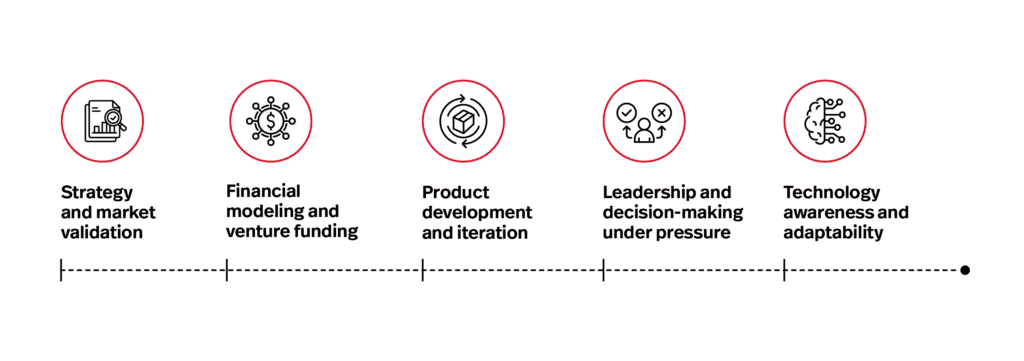
High‑impact entrepreneurship development programs address each stage of the venture lifecycle, from ideation to growth, while surrounding you with mentors, peers, and advisors who've done it before.
What classes to take for entrepreneurship
Start with entrepreneurship courses that build core founder skills while giving you room to experiment. At D'Amore-McKim, these courses are designed to do both. Entrepreneurship education develops leadership, strategic thinking, decision-making, and a strong understanding of emerging technologies.
The entrepreneurship courses were really impactful. We were able to apply what we learned in marketing and strategy directly to our startup, which helped us refine our ideas and make progress each semester.
Alex Tian, MS in Management'24
Here's a closer look at top entrepreneur courses that drive entrepreneurial development:
Developing and validating ideas
Entrepreneurs spot opportunities, but ideas only matter when they are shaped, tested, and refined. D'Amore-McKim's Business Planning for New Ventures helps you structure early-stage thinking by guiding you through idea development, feasibility evaluation, and business model design from both the entrepreneur's and investor's perspectives.
Skill focus: Idea development, feasibility analysis, funding, and venture strategy.
Course highlight: Business Planning for New Ventures provides a step-by-step approach to developing and pitching a business plan, helping you clarify how an idea can evolve into a viable venture concept.
Testing and adapting a business idea
Before launching, entrepreneurs must test assumptions and adapt quickly. The Iterative Product Prototyping for Engineers course at D'Amore-McKim teaches the iterative process that transforms concepts into market-ready solutions. From initial sketches and process flows to prototype development, testing, and analysis, you gain hands-on experience improving and evolving your ideas over time.
Skill focus: 3D printing, SolidWorks, off-the-shelf hardware-software interfaces, simulation, embedded systems, and product testing.
Course highlight: You'll learn the art of iteration and how to turn entrepreneurial ideas into market-ready solutions through Interactive Product Prototyping for Engineers.
Building entrepreneurial leadership skills
Entrepreneurial leaders identify opportunities where others see obstacles. Effective entrepreneurial leaders drive innovation, inspire teams, and navigate the complexities with incomplete data.
Skill focus: Leadership challenges, live case studies, experiential exercises.
Course highlight: The Entrepreneurial Mindset of Leaders explores how psychological traits and leadership techniques shape successful entrepreneurs. Through real-life examples and experiential exercises, you'll learn how to foster relationships, drive change, and lead ventures effectively.
Innovating with emerging technology
Technology, demographic shifts, and changing regulations create opportunities for innovation. Staying ahead requires understanding trends, disruption, and research strategies. Exploring the intersection of entrepreneurship and corporate innovation helps you see how emerging technologies reshape markets and create new business opportunities.
Skill focus: Technology disruption, diffusion, life cycles, and R&D strategy.
Course highlight: Emerging and Disruptive Technologies examines how new technologies move from research to commercialization, helping you understand how startups and established companies leverage innovation to create new market opportunities and competitive advantage.
My first introduction to D'Amore-McKim came through the 50:50 Startups accelerator in Israel, with Northeastern providing academic and mentoring support. Seeing a business school so actively involved in global entrepreneurship and innovation left a strong impression on me.
Daniel Hasan, MBA'25
How experience amplifies entrepreneurship development
Taking the right entrepreneur classes is only part of the equation. As you evaluate what classes to take for entrepreneurship, it's important to look beyond coursework alone and consider the broader support system that helps founders apply ideas in real-world settings.
At Northeastern, experiential learning is the foundation of entrepreneurship education. You don't just learn frameworks—you apply them with real feedback, real stakes, and real mentors.
Northeastern University's entrepreneurial ecosystem surrounds you with resources that many founders never get access to. From startup labs and venture accelerators to mentorship from investors and seasoned entrepreneurs, students gain hands-on experience that mirrors the real-world process of launching a company.
Key entrepreneurship resources and experiential opportunities:
| IDEA Student-Led Venture Accelerator | Develop a venture, test it with real users, and, if it gains traction, launch it with access to funding, mentorship, and operational resources. IDEA is designed for early-stage founders who want to actively build and bring ideas to market, not just study them in theory. |
| McCarthy(s) Venture Mentoring Network (VMN) | Connect with experienced entrepreneurs, investors, and industry experts who offer one-on-one mentorship as you refine your business plan, prepare your pitch, and navigate the challenges of launching and scaling your venture. This direct access to experienced mentors helps you pressure-test ideas early, learn from real-world experience, and make more informed decisions as your venture develops. |
| Entrepreneurship & Innovation Group (E&I) | Learn from faculty who have launched companies, invested in startups, and consulted globally across industries. They bring real-world experience in scaling ventures, securing funding, and driving innovation into the classroom. |
What graduate program supports my entrepreneurship education best?
Aspiring entrepreneurs benefit most from degrees that combine strategic thinking with practical execution. At D'Amore-McKim, you can tailor your entrepreneurship education to your goals, whether you're exploring your first business idea, preparing to launch a venture, or building leadership skills to drive innovation within an existing company.
A broad business degree, such as an MBA, or the MS in Management, provides the full toolkit to build, grow, and lead a business. It prepares you to think like an owner, not just an innovator. Skills gained through these programs include:

From there, a concentration in entrepreneurship lets you go deeper, so you're not just learning about business, you're actively learning how to launch and scale one. You'll master a number of entrepreneurial skills, including:

For students seeking faster options that are both focused and flexible, the Graduate Certificate in Entrepreneurship delivers specialized entrepreneurship coursework in as little as eight months. The 12-credit program explores areas such as:
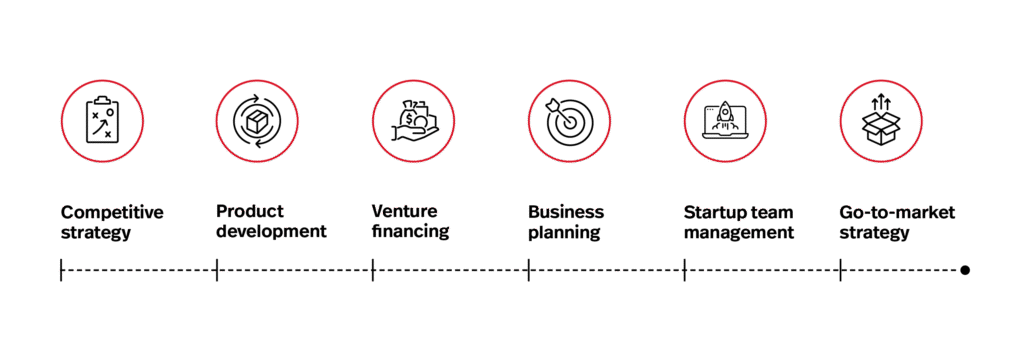
The Graduate Certificate in Entrepreneurship is particularly valuable for professionals testing new ideas while working, early-stage founders seeking structure and mentorship, and innovators looking to strengthen their entrepreneurial skill set. Learning alongside other aspiring founders and innovators also creates opportunities for collaboration, feedback, and idea development.
As you evaluate your options, exploring what degree you should get to become an entrepreneur can help clarify which path aligns best with your goals and experience level, especially when you're deciding what classes to take at different stages of your entrepreneurial journey.
Across all pathways, D'Amore-McKim combines business education with experiential learning, helping students build the confidence, strategic mindset, and practical skills needed to move ideas forward.
Level up your entrepreneurial development with D'Amore-McKim
If you've been searching for what classes to take for entrepreneurship or looking for entrepreneur classes that go beyond surface-level theory, it's time to take the next step. At
D'Amore-McKim, you don't just study entrepreneurship; you actively build the skills, experience, and confidence to bring your ideas to life.
At D'Amore-McKim, you don't just learn entrepreneurship. Through hands-on learning, expert faculty, and a strong network of mentors and employers, you'll gain the tools to design, launch, and scale ventures in today's fast-moving business environment. Whether you're refining an idea or exploring where to start, you'll be supported every step of the way.
Take the next step:
Your future as a founder starts with the right foundation. Take the next step today.
- Connect with our admissions team at an event to explore programs and resources
- Request more information about the program that interests you most
- Start your application online and begin shaping your entrepreneurial journey
Key takeaways:
- D'Amore-McKim entrepreneur classes pair core business fundamentals with real-world projects, mentorship, and a strong startup network to help students move from idea to execution.
- From ideation and feasibility testing to leadership development and emerging technologies, D'Amore-McKim's entrepreneurship coursework is designed to mirror the real lifecycle of building a venture.
- Venture accelerators, mentorship networks, and applied programs like the MBA, MS in Management, or Graduate Certificate in Entrepreneurship will help you refine ideas, test markets, and launch with confidence.
Explore Related Articles



Connect with admissions
Café Connections – Boston Campus
Graduate Accounting Programs “Ask Me Anything”
D'Amore-McKim Ask Me Anything
Request More Information
Our graduate programs are specifically designed to meet the needs of students and professionals in this fast paced and changing global economy. Sign up to receive more information about the program that interests you most.