

Updated: June 10, 2026
You've got ambition. Maybe even a big idea. The real question is: can you bring it to life?
That's where entrepreneurial leadership comes in. Unlike traditional leaders who focus on stability and keeping things running, entrepreneurial leaders are builders. They see opportunities where others see obstacles. They act boldly, test new ideas, and push boundaries to turn vision into reality.
If you're serious about standing out as an entrepreneur, you must learn how to adapt when plans shift, stay creative under pressure, and inspire others to rally around your vision. Instead of playing it safe, entrepreneurs turn challenges into opportunities and move confidently toward their goals.
How you build these skills matters. At Northeastern University's D'Amore-McKim School of Business, an experience-driven approach helps you develop the judgment, agility, and perspective needed to lead in uncertain environments. In this guide, you'll discover what entrepreneurial leadership is, the nine characteristics of an entrepreneur you can develop to sharpen your edge, and how these traits can help you inspire teams, navigate uncertainty, and bring your ideas to life.
What sets entrepreneurial leaders apart
Entrepreneurial leadership isn't just facing uncertainty; it's thriving in it. While others may hesitate in uncertain, fast-changing environments, entrepreneurial leaders lean in, seeing every shift as a chance to grow. The key is embracing risk by taking calculated steps and staying closely connected to the work as it evolves. That hands-on approach shows up in a wide range of responsibilities they take on:
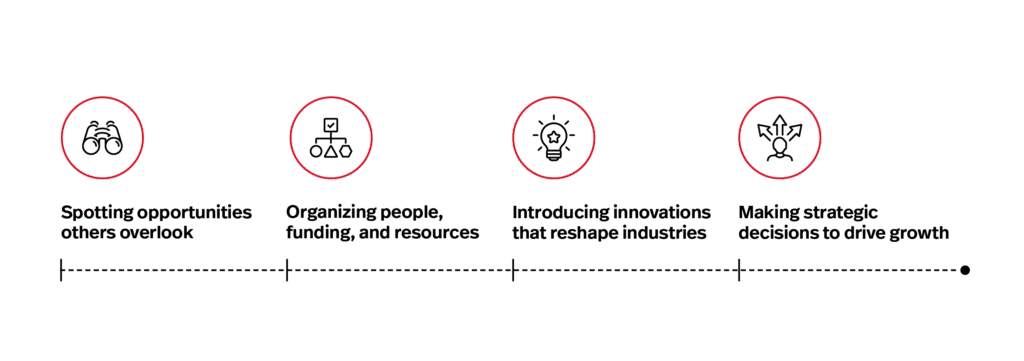
Instead of sticking to established plans, you'll need to test ideas, pivot when things don't work, and continue refining until you see results. The most successful entrepreneurial leaders think strategically and stay grounded in their vision, while bringing others along by building trust and alignment across their teams and investors.
Characteristics of an entrepreneur: What makes a good entrepreneurial leader?
Great entrepreneurs build momentum with every step. Their success comes from a willingness to experiment, learn, and try new approaches. Entrepreneurial leaders adapt strategies, learn from setbacks, and stay flexible in dynamic situations. When things shift, they don't panic. They pivot.
One of the most important characteristics of an entrepreneur is the ability to build trust. Investors, team members, and partners look for leaders who are committed to their vision and confident in their abilities to navigate challenges. That credibility opens doors and keeps the venture moving forward.
Entrepreneurial leadership involves inspiring other. Entrepreneurs create a shared sense of purpose and align teams around ambitious goals, fostering collaboration and confident decision-making. From securing funding to developing proof-of-concepts, prototyping, staffing, and scaling operations, their guidance turns ventures from concept to reality.
In today's fast-moving markets, entrepreneurial leaders drive change. They make smart decisions under uncertainty, adapt quickly, and build business models that can grow and endure. By leading with vision and staying hands-on, they shape their ventures' success and their impact on their teams and industries.
Entrepreneurial leadership: Your guide to success
While every entrepreneur's journey is unique, the most successful entrepreneurial leaders tend to share a common set of traits. These characteristics help them adapt, inspire, and lead with confidence, especially in fast-moving, high-stakes environments. If you're aspiring to become an entrepreneurial leader, these are the qualities to cultivate:
1. Creativity and strategic vision
Entrepreneurial leaders think big and plan smart. They combine visionary thinking with strategic planning to craft a clear roadmap from launching a startup through guiding teams toward shared goals. Their creativity fuels innovation, while their vision keeps everyone aligned.
2. Calculating risk-taking and learning from failure
Successful leaders take calculated risks for greater rewards. They are comfortable with ambiguity, balancing tradition with innovation. Rather than fearing failure, they treat setbacks as a critical part of the learning process, using them to refine and strengthen their approach.
3. Adaptability
Entrepreneurial leaders are agile, able to respond effectively to market disruptions and dynamic environments. Their adaptability allows them to navigate change with clarity, solve complex problems, and challenge existing industry norms to uncover better solutions. As an entrepreneur, you'll need to consider factors that are constantly changing:

4. Confidence and decisiveness
Strong entrepreneurs know their strengths and build teams that complement them. They gather relevant data, make informed, timely decisions, and move forward confidently, especially when stakes are high and time is limited.
5. Ability to delegate
No one builds a business alone. Recognizing personal strengths and weaknesses, entrepreneurs delegate tasks to partners or teammates with complementary skills, enabling the venture to scale efficiently.
6. Inspiring others
From the startup stage onward, entrepreneurial leaders lead by example. They create a sense of purpose that motivates others, encouraging teams to embrace change and pursue ambitious goals.
7. Transparency and receptiveness
Honesty and openness build trust. Successful entrepreneurial leaders create a collaborative learning culture where feedback is welcome and ideas can evolve, ensuring diverse perspectives are heard and valued.
8. Perseverance
Entrepreneurial leadership requires grit. These leaders remain committed to their vision and maintain optimism in the face of obstacles. They use challenges as opportunities for growth, keeping long-term goals in focus.
9. Commitment to growing a talented team
Effective leaders know how to grow their teams at the right time, balancing company progress with employee growth. By prioritizing people, they build strong relationships and create the foundation needed to solve complex challenges.
Build your professional toolkit
If you're ready to develop the characteristics of an entrepreneur, D'Amore-McKim is the place to start. At the heart of Northeastern's entrepreneurial ecosystem, D'Amore-McKim offers graduate programs designed to help you build a comprehensive entrepreneurial toolkit:


Across these programs, you'll develop the essential skills that define entrepreneurial leadership:

What sets D'Amore-McKim apart is its commitment to experiential learning and global impact. You'll learn from faculty deeply connected to the innovation economy, offering mentorship grounded in real-world experience. These esteemed faculty members bring:

The McCarthy(s) Venture Mentoring Network (VMN) will connect you with experienced entrepreneurs and mentors, while the Entrepreneurship & Innovation (E&I) faculty bring together seasoned founders, investors, and advisors who know what it takes to succeed. Together, they create a collaborative environment where you can get practical, real-world advice and turn your ideas into action.
While working on building a small startup in my spare time, I realized I needed to deepen my business knowledge. Seeing a business school so actively involved in global entrepreneurship and innovation left a strong impression on me.
Daniel Hasan, MBA'25
You'll also have access to powerful resources like IDEA, Northeastern's student-led venture accelerator. From business plan development to prototype funding, IDEA offers workshops, guidance, and a collaborative environment to test and refine business ideas.
The accelerator's structured Ready, Set, Go framework provided guidance at every stage, and its resources helped us secure our first round of GAP funding, turning our idea into a functioning startup.
Danying Zheng, MS in International Management'24
Start your entrepreneurial journey today
Whether you're just starting out or ready to scale your venture, D'Amore-McKim provides the education, resources, and support to help you build a professional toolkit and make your mark as an entrepreneurial leader.
Take the next step by learning more about the opportunities D'Amore-McKim offers. Explore our programs and sign up for an upcoming info session today! Your entrepreneurial career begins now.
Key takeaways:
- Entrepreneurial leaders build, innovate, and drive growth. They are visionary thinkers who act boldly and chart paths to drive innovation, turning imagination into impact.
- Nine key traits define successful entrepreneurial leaders: creativity, risk-taking, adaptability, confidence, delegation, inspiration, transparency, perseverance, and team development.
- Choosing the right graduate program can build your entrepreneurial toolkit. D'Amore-McKim's programs equip you with the skills, experience, and perspective to turn ideas into action.
Explore Related Articles



Upcoming admissions events
Graduate Accounting Programs “Ask Me Anything”
D'Amore-McKim Ask Me Anything
Forte Forum – Boston
Life in Oakland: Housing, Community, and More
Request More Information
Our graduate programs are specifically designed to meet the needs of students and professionals in this fast paced and changing global economy. Sign up to receive more information about the program that interests you most.