
Published: Mar. 3, 2026
If you're exploring graduate programs in finance, you already understand how competitive the field can be. Employers look beyond grades for evidence that candidates can analyze markets, build financial models, and make sound decisions under real-world conditions. Yet not every business school provides opportunities to apply those skills in live investing environments.
For students pursuing careers in investment banking, corporate finance, asset management, or quantitative roles, gaining practical investing experience during graduate study can significantly strengthen preparation for the job market. The right program allows students to build that experience before they graduate, translating academic knowledge into applied expertise.
This guide breaks down why hands-on investing matters, the opportunities you should look for, and how Northeastern University's D'Amore-McKim School of Business helps you build the practical skills needed through The 360 Huntington Fund and its graduate finance programs.
What is the best way to learn investment banking?
Finance education begins with models and frameworks, but real markets run on uncertainty, incomplete information, and human behavior. In the space between classroom theories and real-world intricacies lies the need for real-world, actual money experience. It's practical exposure that turns theory into judgment.
Textbooks cannot replicate the complexity of evolving markets. When you work with real data, collaborate with peers, and make investment decisions, you build perspective, sharpen your intuition, and strengthen the communication skills needed to navigate uncertainty and stakeholder expectations.
You benefit from opportunities to:
- Apply valuation and portfolio theory to real market conditions
- Work with live data and industry-standard financial tools
- Strengthen technical skills in modeling, analytics, and risk assessment
- Gain confidence by presenting and defending investment ideas
- Develop professional judgment that extends beyond classroom learning
- Have a say in stock picks and portfolio construction
- Gain management skills by leading other students
In a field where employers seek job-ready talent, investment experience is not simply beneficial. It is a meaningful differentiator.
What is The 360 Huntington Fund?
One of the most powerful ways for a graduate student to learn investment banking is to help manage a real mutual fund. At Northeastern, The 360 Huntington Fund gives students exactly that opportunity.
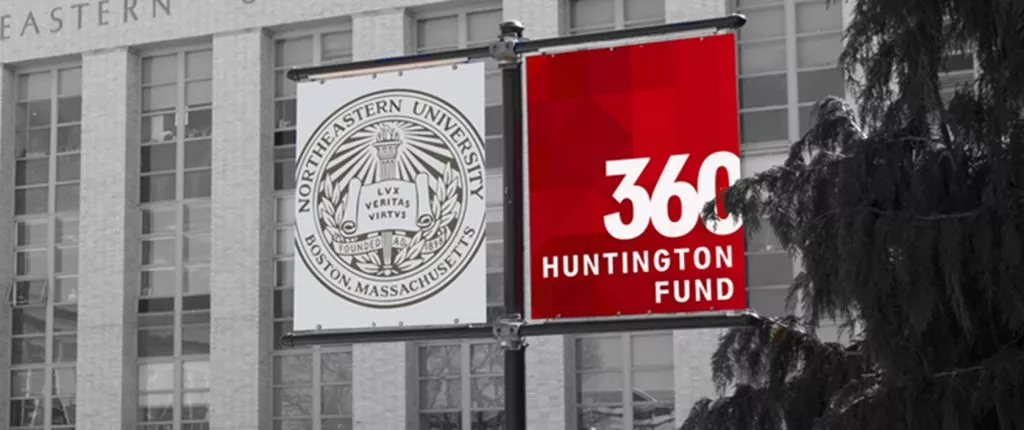
The Fund is a real-money, multi-million-dollar, student-run, and actively managed mutual fund that invests a portion of Northeastern University's endowment. Its objective is clear: outperform the Russell 3000 through disciplined research, portfolio construction, and long-term decision-making.
As a member of The Fund, you'll conduct fundamental and quantitative research to identify undervalued opportunities, build investment theses, and manage a diversified portfolio of US public equities. The Fund manages real capital, so the stakes are real. Performance is tracked over time, and decisions are evaluated based on both return and risk.
Once you're a student, you can participate for up to three semesters in the MS in Finance and MS in Quantitative Finance programs, or six semesters in an MBA program on the Boston campus. Most start as analysts and move into leadership roles as they build experience. If you have investment experience, you can apply for a management position to focus on portfolio management and governance.
Managing The 360 Huntington Fund shaped my career aspirations. The Fund's focus on investing in US public equities and managing portfolio holdings inspired me to pursue a role in investment management that combines my research background with practical investment skills.
Isha Kulkarni, MS in Quantitative Finance '24 and 2024 Managing Director of The 360 Huntington Fund
What do you learn by managing real capital?
Participation in The 360 Huntington Fund develops both technical and professional skills. On the technical side, you deepen your expertise in valuation, financial modeling, equity research, and risk management. You learn how to assess assumptions, evaluate downside risk, and monitor performance over time.
The skills that emerge through collaboration are equally important. You work in teams, debate investment ideas, present stock pitches, and defend your recommendations. New fund members are paired with more experienced peers, reinforcing mentorship and shared accountability.
What truly set D'Amore-McKim apart for me was experiential learning, particularly through The 360 Huntington Fund and the graduate co-op. Getting experience in a real mutual fund and gaining professional work experience sounded amazing, and once I discovered these, I knew this was the perfect program for me.
Sumit S., MS in Quantitative Finance'24
Managing uncertainty is a constant part of the experience. Not every investment performs as expected, and you learn how to reassess decisions, adjust strategies, and improve judgment through reflection and iteration.
Applying industry-standard tools with Bloomberg
Hands-on investing at D'Amore-McKim is supported by professional-grade technology. Northeastern University has exclusive status as a Bloomberg Experiential Learning Partner, giving you access to the Bloomberg Business Lab with 20 Bloomberg Terminals, one of the few programs in the country with this distinction.
Bloomberg Terminals are high-powered computer stations that provide real-time market data, industry-grade analytics, and company research tools. Once you become a graduate student, you'll use it in your coursework and applied learning experiences, such as The 360 Huntington Fund, mirroring how investment professionals work in practice.
Key benefits include:
- Real-time market data for research and analysis
- Industry-grade analytics for financial modeling and portfolio assessment
- Comprehensive company research tools for equity and investment evaluation
- Opportunities to earn Bloomberg certifications that demonstrate technical expertise
This hands-on exposure will prepare you for a finance career, giving you both practical skills and technical confidence.
Rigorous academics as the foundation for real-world application
To have a successful career in finance, you need a graduate degree that does more than expand your technical knowledge. It should sharpen analytical thinking, deepen market understanding, and prepare you to make decisions under real-world pressure.
The strongest programs pair rigorous academics with applied experience. Advanced theory equips you to evaluate risk, interpret financial signals, and assess value with precision. Without that depth, hands-on learning lacks context. With it, experience becomes transformative.
At the D'Amore-McKim School of Business, coursework in finance, analytics, and strategy provides that foundation. Its faculty brings extensive industry experience and global perspectives to the classroom, preparing students to understand value creation, investment strategy, and market dynamics.
| MS in Quantitative Finance emphasizes advanced mathematical, statistical, and computational methods to model financial markets, assess risk, and develop algorithmic trading strategies. You gain deep technical expertise in quantitative methods, financial engineering, and data-driven decision-making. |
| MS in Finance focuses on applied finance, corporate strategy, and investment analysis. You develop expertise in valuation, portfolio management, corporate finance, and market analysis, preparing you for roles in investment banking, asset management, and corporate finance. |
| MBA programs—Full-Time and Part-Time study options provide a broad business foundation with core finance coursework and concentrations in corporate finance, investment analysis, portfolio management, and mutual fund management. |
| MS in Management, with full-time and part-time study options, offers finance concentrations while developing leadership, strategic decision-making, and organizational skills. The program's flexibility prepares you to accelerate or change career paths. |
Across programs, you build expertise in valuation, financial modeling, quantitative methods, ethics, and regulatory compliance. Just as important, hands-on learning is woven throughout your experience, preparing you to apply those skills through initiatives like The 360 Huntington Fund.
As you compare graduate finance programs, ask:
- Will I have the opportunity to apply what I'm learning?
- Will I gain real experience that employers respect?
- Will I graduate confident, not just knowledgeable?
Not all schools offer student-managed funds, Bloomberg access, or experiential learning embedded throughout the curriculum. D'Amore-McKim does. You work with real capital and real data, seeing how markets evolve, how decisions shape portfolios, and why models matter beyond the classroom.
The result is more than a degree. You graduate with applied investing experience, strong technical skills, and the confidence to contribute from day one.
Preparing for finance careers through integrated experience
D'Amore-McKim stands out for intentionally integrating experiential learning across graduate finance programs. Collaborating with peers on stock pitches, risk assessments, and strategy discussions develops communication, leadership, and problem-solving skills. These abilities are as important as technical expertise in fast-moving finance environments.
When you earn your graduate degree here, you'll leave with more than academic knowledge. You'll gain practical investing experience, proficiency with professional tools, and the confidence to contribute meaningfully in finance and investment roles.
Why launch your finance career at D'Amore-McKim
In a competitive finance job market, employers seek candidates who can think critically, navigate uncertainty, and make informed decisions. Managing real capital through The 360 Huntington Fund gives you that advantage.
By combining hands-on fund experience, rigorous academics, and access to Bloomberg technology, D'Amore-McKim prepares you to launch your finance career with clarity, confidence, and a competitive edge.
Ready to take the next step? Explore D'Amore-McKim's programs, fill out the information form to receive event invitations and other important info, and dive into The 360 Huntington Fund. Your career in finance begins here.
Key takeaways:
- Experiential learning helps you apply theory in real market conditions.
- Now in its 18th year of operations, The 360 Huntington Fund offers real-money investing experience for students.
- Students are trained from the ground up as analysts, and upon completing the class, they can independently create original stock analyst research reports.
- Students can move on to the next level and manage people and the portfolio, moving beyond individual stocks.
- You can build technical skills in valuation, modeling, and risk analysis alongside leadership and communication skills.
- Bloomberg Terminal access and certifications are integrated into the course, so you gain valuable expertise.
- D'Amore-McKim's experiential approach prepares you to transition confidently into finance careers after graduation, with many success stories in its history.
Discover related articles:


Full-Time MBA
Build an entrepreneurial mindset, future-ready skills, and broad business expertise with Northeastern's experience-powered MBA.

Part-Time MBA
The MBA for working professionals. Prepare to lead in a complex, connected, digital-first economy.

Finance
Advance your finance career and deepen your expertise in core financial concepts—all on a flexible schedule tailored to Boston professionals.

Quantitative Finance
Learn data-driven financial analysis and the application of advanced quantitative techniques in a program designed for tomorrow's global financial leaders.

Management
Build your business foundation and explore your interests for real world impact.


