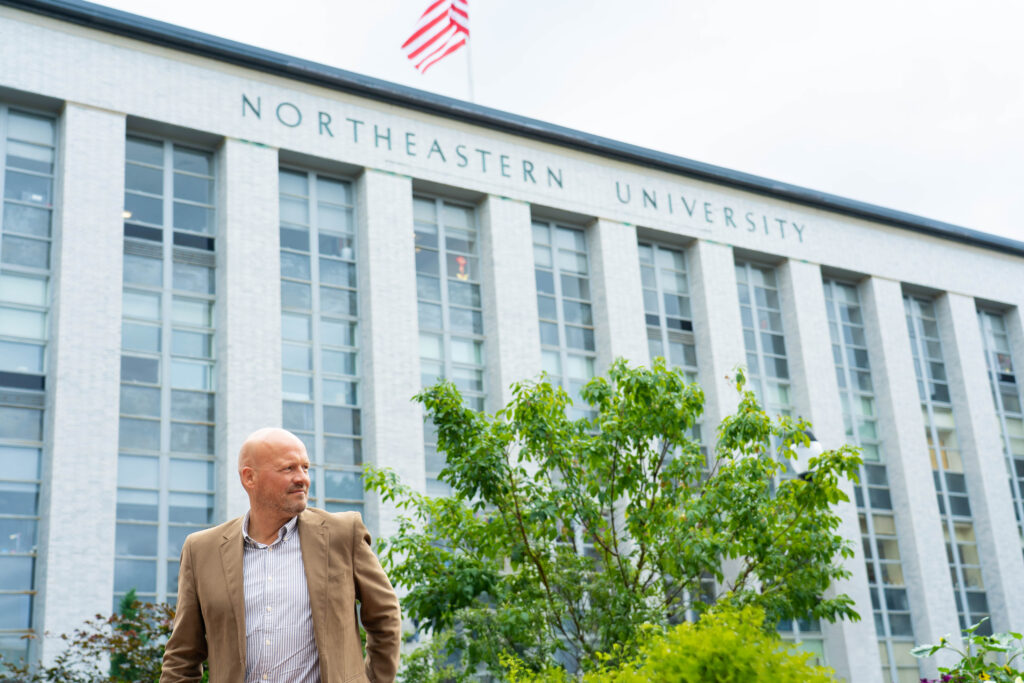
What happens when a professor turns his research vision into something students can experience firsthand? For Frank Hartmann, the answer became Be Frank, a new tool designed to help students engage more deeply with his accounting case studies while giving him a window into how they approach complex problems.
Hartmann, the Golemme Research Chair and Professor of Accounting at the D'Amore-McKim School of Business, first presented the idea behind the project at DMSB Day. His focus was cognitive offloading and cognitive scaffolding: understanding when people use technology to simply find an answer and when they use it to build a deeper understanding of a problem.
With support from the D'Amore-McKim AI Strategic Hub (DASH), Hartmann began turning that research question into something he could test in his own classroom.
“We worked with Frank to understand how thought leaders prepare future leaders in accounting,” says Kwong Chan, Senior Academic Specialist and Executive Director of DASH. “It turns out an interactive case study allows students to explore key issues such as ethical views held by senior leaders, and possible actions and their likely consequences. We built Be Frank as an extension of the classroom that allows Professor Hartmann to ask even deeper questions in class. The fact that students can try out decisions with the live case study even before the class discussion allows for a real-time simulated experiential experience.”
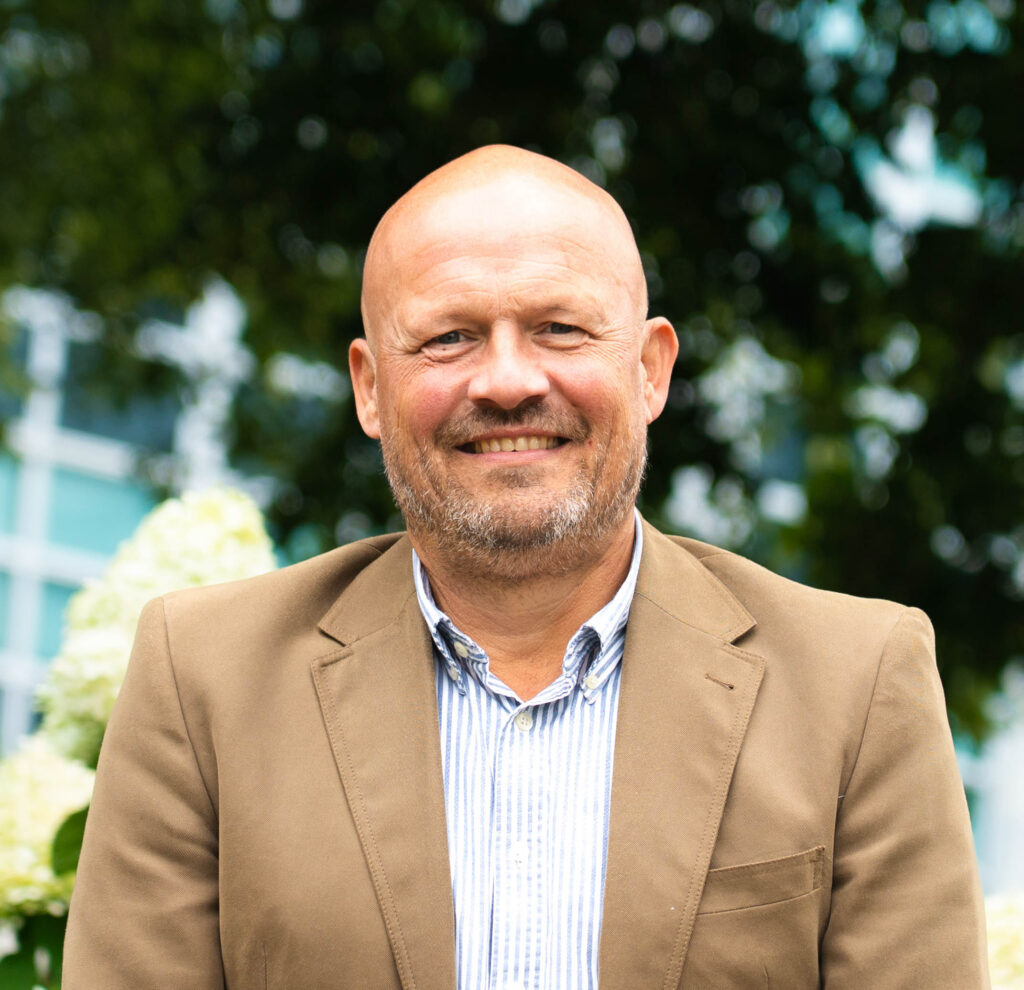
The idea is that you can use these answering machines as an answer to any questions in the classroom, Or you can actually use them to scaffold yourself to a higher level of understanding of the problem.
Frank Hartmann
Building a tool around the case
Rather than asking students to work through a generic AI application, Hartmann and DASH developed Be Frank around his own case-based teaching. For the initial project, Hartmann created a case based on the real-world experience of an airline that went bankrupt. Students could interact with the tool as they worked through the case, asking questions and using the responses to develop their own analysis. The approach allowed Hartmann to create a more focused classroom experience while also capturing information about how students interacted with the case.
“We could observe whether they would use it in a more offloading sense, give me an answer, or a more scaffolding sense by asking serious questions about the things they were unclear about,” Hartmann says. That information is central to the project's research potential. The goal is not simply to build another classroom technology, but to learn from how students use it and continue refining the experience.
The first iteration also gave Hartmann and DASH a starting point for what comes next. The team plans to improve the classroom tool and eventually use the data generated through student interactions to support further research. “The idea is that the data we generate, we could also use for publications,” Hartmann says. “We could interpret what students do and also write papers about that.”
Where research meets the classroom
For Hartmann, the collaboration with DASH illustrates one advantage of having a dedicated team that can help faculty turn an idea into something students can actually use. “The challenge for a school like ours and for DASH is how to connect these wild ideas of academics with a real tool that's working,” he says.
That connection allows faculty to experiment with new approaches while keeping the technology tied to a specific teaching and research question. In Hartmann's case, that question started with how people learn and how technology can support that process. It became a classroom experiment, a new tool, and a way to study student behavior at the same time.
The experience also reinforced Hartmann's interest in developing Be Frank beyond a single classroom application. He envisions a future version that could support classroom learning, self-directed learning, and eventually professional education. For now, the focus is on getting the classroom experience right. “I would like to have the target to have the classroom tool really foolproof,” Hartmann says.
That iterative approach, moving from an academic idea to a working tool, helped Hartmann observe how students interact with the case, better understand how technology can support learning, and help students work through uncertainty, ask better questions, and develop their own conclusions.
For Hartmann, it also offers a way to make technology serve the case study rather than replace it. “We're not just training students,” he says. “We're training accountants.”