For veterans navigating the job market, finding the right opportunity can depend on more than matching a resume to a job description. It can depend on having someone who understands their experience, asks the right questions, and helps make the right connection.
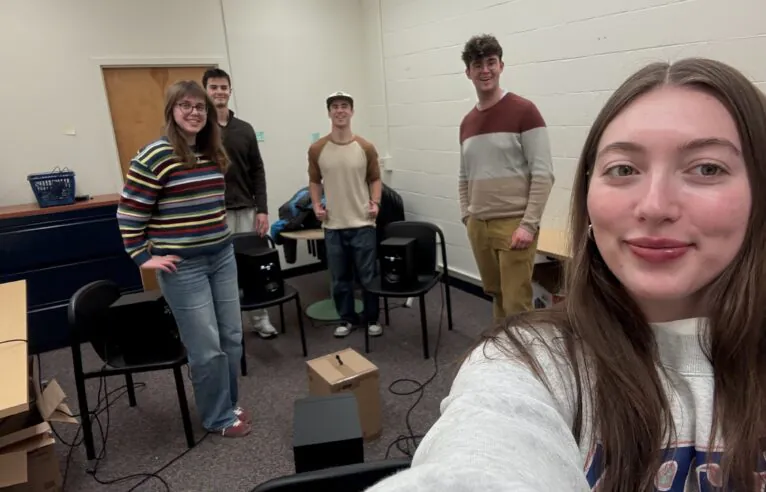
That human connection is at the center of a project developed by graduate students in Kwong Chan's AI-focused practicum at the D'Amore-McKim School of Business. Working with Veteran Hiring Solutions (VHS), a startup that connects veterans with hiring managers through video job descriptions, the team focused on HENDO, an AI-powered bot that VHS founder Justin Henderson had already built on Delphi AI to capture his communication style and interact with veterans. Their task was to help strengthen and refine the tool, with the longer-term goal of gathering information that could help Henderson more efficiently identify and match veterans with potential hiring managers.
“Using AI to extend human expertise to other humans is at the core of DASH's mission,” says Kwong Chan, Senior Academic Specialist and Executive Director of the D'Amore-McKim AI Strategic Hub. “Having only one Justin shouldn't be a barrier to making sure talent reaches the right place. Applying the context of digital twins to scale Justin's knowledge was a natural step in making it possible for more people to benefit from the unique methodology that VHS brings to the world.”
Rakshitha Chandrikachar, a graduate student in the Engineering Management program, served as the project's client lead. She worked closely with Henderson through weekly meetings to understand his vision, translate his needs into project requirements, and help guide the team toward the outcomes that mattered most to the client. For Chandrikachar, the project quickly demonstrated that building a useful AI tool requires more than getting a chatbot to produce intelligent responses. “The quality of the underlying information and how the AI fits into an existing business workflow are equally important,” she says.
Turning a human approach into an AI system
One of the team's biggest challenges was capturing what made Henderson effective in his conversations and translating those qualities into something an AI system could replicate and evaluate. Students studied videos of Henderson interacting with hiring managers, reviewed his digital communication, and examined his tone, language, and conversational patterns. They even gathered observations about his speech patterns and filler words to better understand the characteristics that made his communication feel authentic.
The team then developed measures to evaluate HENDO's performance, including how natural and empathetic the bot sounded, how closely it reflected Justin's communication patterns, and how well it reasoned through its responses. “When we were trying to make the bot sound like Justin, that was something that was very subjective,” Chandrikachar says. “We had to figure out how to translate that into something we could actually build and evaluate.”
The process also showed the students how closely AI performance can be tied to the quality of the information behind it. The team found that HENDO's knowledge repository contained information irrelevant to its intended purpose. After cleaning and refining the data, they retested the system and saw improved performance.
Designing AI around people
Because HENDO is ultimately intended to interact with veterans navigating the job-search process, the team placed particular emphasis on making the experience feel human. “We weren't simply building a chatbot that needed to answer questions correctly,” Chandrikachar says. “HENDO would eventually be interacting with veterans who were navigating the job-search process, so the quality of the interaction mattered.”
That meant thinking beyond automation. The goal was to capture elements of Henderson's knowledge and personal approach so HENDO could support the early stages of the process while allowing him to focus more of his time on the relationship-building that cannot be automated. The team also considered how HENDO could eventually connect with the systems VHS already uses, including its customer relationship management platform and social channels. While those integrations were outside the scope of the semester's implementation, planning for them demonstrated another important lesson: An AI tool becomes more useful when it fits naturally into the way a business already works.
“When I look at AI, I look at how I can build tools that will empower my veterans to go get what they need to get on their own,” Henderson says. “What I liked about this clone was that it gave them a safe place to talk to a version of me, somebody they're comfortable with. The ego in that conversation is removed, and we're creating a safe place for them to have these types of conversations. When the time is right, that direct conversation, human to human, happens. This just creates a safe place to start the conversation.”
Scaling the human impact
For Chandrikachar, the project changed how she thinks about what AI can contribute to a business. “I primarily thought about AI in terms of what it could automate or how efficiently it could perform a task,” she says. “Working with VHS, I realized that the real value of AI can come from scaling human expertise without necessarily removing the human from the process.”
That distinction shaped the team's work with HENDO. The goal was never simply to build a replacement for Henderson. Instead, the students explored how technology could make some of his knowledge and approach available at a greater scale, helping him spend more time doing the work that matters most: building relationships and connecting veterans with the right opportunities.
The project reflects the practicum's broader purpose: students work with real organizations to explore how AI can address specific business challenges. Through DASH, D'Amore-McKim faculty have access to the technical support needed to move an idea from a business problem toward a working solution.
For Henderson, the experience of working with a student team left as much of an impression as the tool itself. “I have leadership and development experience, so I was able to understand each one of those people — how they prefer to be communicated with and the value they want to bring to the project,” he says. “I really enjoyed the passion behind it — that it was more about self-development than getting money.”