Published: Nov. 2, 2026
Artificial intelligence is changing the way businesses operate, compete, and make decisions. Today, AI can summarize reports in seconds, predict customer behavior, and automate work that once took hours.
As these tools become part of everyday business, the question is no longer whether leaders should use AI. It's how they can use it thoughtfully to solve problems, support their teams, and make better decisions.
That means tomorrow's leaders will need more than a basic understanding of AI tools. They'll need to know when to rely on AI, when to rely on human judgment, and how to balance innovation with ethics, trust, and accountability. While conventional business degrees lay a strong foundation, understanding how an AI MBA compares to a traditional MBA highlights how business education is adapting to meet these modern demands. The organizations that thrive will be led by people who can bring those skills together.
That's exactly what Northeastern University's D'Amore-McKim School of Business MBA in artificial intelligence is designed to do. Built for the AI-powered economy, this accelerated STEM-designated technology leadership program combines advanced analytics, experiential learning, and human-centered leadership development to prepare you to lead with confidence in a rapidly changing business world.
Why tech fluency is becoming essential for business leaders
Not long ago, many executives could leave technical decisions to IT teams while focusing primarily on business strategy. Today, that approach is becoming increasingly difficult.
AI is shaping everything from customer experiences and supply chains to hiring practices and investment decisions. Leaders don't need to become programmers, but they do need to understand how AI works, where it creates value, and what risks it introduces. As organizations continue to embrace AI, leadership in AI requires the confidence to ask the right questions, evaluate new technologies, and make informed decisions.
This is where tech fluency becomes essential.
Tech fluency means understanding the capabilities and limitations of technologies such as AI, machine learning, automation, data analytics, fintech, and digital platforms. More importantly, it means knowing how to connect those technologies to business strategies and identify opportunities to create value.
Organizations are increasingly looking for leaders who can bridge the gap between technology and business. That's one reason an MBA in artificial intelligence has become such a valuable credential for professionals preparing to lead in an AI-powered economy. Rather than training students to become engineers, the program helps future business leaders build the technical understanding and strategic perspective needed to lead with confidence.
But technical knowledge alone isn't enough. The most effective leaders also know how to communicate clearly, build trust, and make thoughtful decisions that put people first. That's why D'Amore-McKim's approach combines technical fluency with human-centric AI, preparing graduates to lead organizations where technology and human judgment work together.
The human side of AI is becoming more important, not less
How has technology changed leadership? One of the biggest shifts is that, as AI becomes more capable, human judgment becomes more valuable. Organizations need leaders who can combine technical understanding with empathy, ethical reasoning, and strategic thinking.
Professor Koen Pauwels calls this the “AI Authenticity Paradox”. As AI becomes increasingly capable of generating content, analysis, and recommendations that resemble human work, qualities like authenticity, judgment, empathy, and lived experience become harder to replicate, and therefore more valuable.
As Pauwels writes:
“AI is getting better. That's exactly why being genuinely you is becoming more valuable.”
Rather than making people less important, AI is raising the value of uniquely human capabilities. Organizations still need leaders who can interpret context, navigate uncertainty, build trust, and make thoughtful decisions that technology alone cannot.
That's why D'Amore-McKim's AI MBA is grounded in Northeastern's human-centric AI approach, helping you learn how to:
- Apply AI responsibly in business
- Combine data with human judgment
- Lead teams through technological change
- Make ethical decisions that build trust
What human-centric AI means for future leaders
As organizations integrate AI across every function, leadership in AI is becoming more strategic, collaborative, and people-focused. Success isn't simply about understanding what AI can do. It's about knowing when to rely on technology, when to rely on human judgment, and how to combine the two to create better outcomes.
That shift is changing what organizations expect from leaders.
Even as AI takes on more analytical and routine work, leaders will continue to be valued for skills that technology can't easily replicate, including:
- Empathy and emotional intelligence
- Clear communication and collaboration
- Developing and empowering teams
- Building trust across organizations
- Long-term strategic thinking
- Ethical decision-making in complex situations
An MBA in artificial intelligence prepares students to strengthen these capabilities alongside technical fluency, helping them lead organizations where people and AI work together rather than compete.
Build tech fluency through an AI MBA
You don't need to be the person building the algorithm. But if you're leading the business, you do need to know what the algorithm can do, where it adds value, and when human judgment should take the wheel.
That's the difference between simply using AI and leading in an AI-powered organization. Tech fluency means understanding the fundamentals behind AI, machine learning, automation, and data analytics, and knowing when and how to apply them through a human-centric AI lens. It's about asking the right questions, recognizing opportunities, and ensuring technology serves strategic business goals while creating positive outcomes for people.
As organizations integrate emerging technologies like AI, blockchain, and fintech, leaders who can connect technical capabilities to business strategy stand out. They can translate data into action, identify opportunities for innovation, and help teams navigate technological change with clarity and confidence.
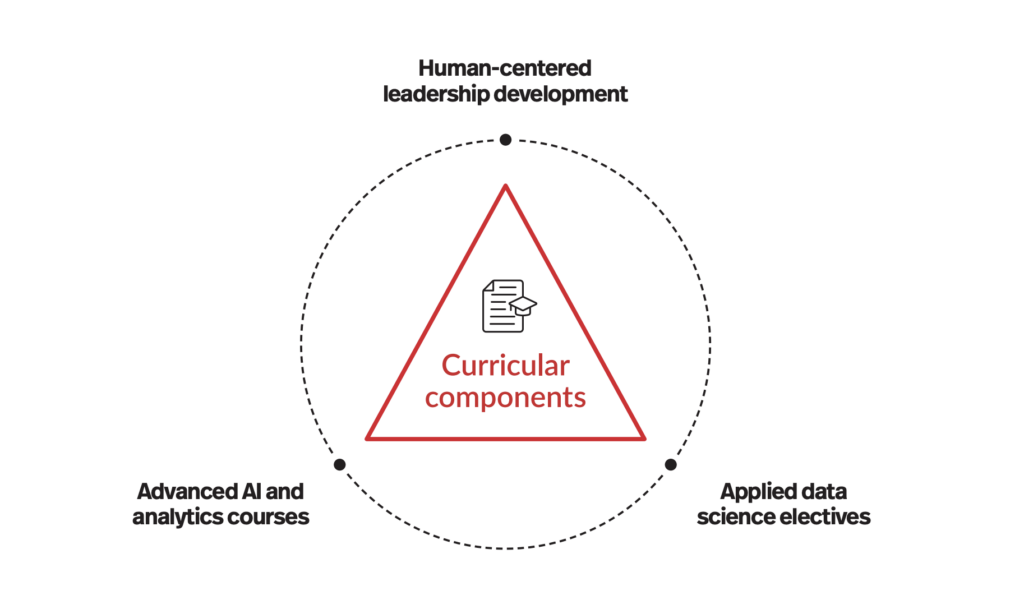
D'Amore-McKim's AI MBA is designed to help you build this fluency while strengthening your leadership skills. As a STEM-designated business degree, the program combines traditional MBA preparation with advanced training in AI, analytics, and emerging technologies.
The D'Amore-McKim AI MBA curriculum includes:
Learning through experience, not just theory
The future of leadership can't be learned exclusively from textbooks.
That's why the MBA in artificial intelligence extends learning beyond the classroom, giving you opportunities to apply what you're learning in environments where business decisions have meaningful consequences. Guided by faculty with expertise in AI, analytics, innovation, and entrepreneurship, you'll work on projects that connect coursework with the challenges organizations are solving today.
| Experiential learning opportunity | Description |
| 360 Huntington Fund | Gain investment management experience through this student-managed mutual fund by researching companies, pitching investment ideas, and helping manage real assets. |
| AI Strategic Hub Research Practicum | Work with faculty and industry partners to solve real business challenges using AI, analytics, and emerging technologies. |
| Community Impact Initiative | Partner with nonprofit organizations to deliver data-informed insights and strategic recommendations that create measurable community impact. |
| Global Field Study | Experience business on the global stage. Immerse yourself in global markets and culture through travel over spring break or early summer. |
| IDEA Student-Led Venture Accelerator | Develop, test, and launch startup ideas with mentorship, funding, and entrepreneurial support through the IDEA accelerator. |
| Washington, D.C. Residency | Explore the intersection of business and public policy through meetings with policymakers, lobbyists, and industry leaders in the nation's capital. |
Through these experiences, you'll practice leadership in AI, solve complex business challenges, and build confidence while applying human-centric AI principles where decisions have real consequences.
The result is a learning experience that bridges classroom knowledge with professional impact.
How the AI MBA prepares you for today's job market
The most effective leaders don't adopt AI simply because it's available. They adopt it because it helps people work more effectively, improve customer experiences, and create lasting business value.
That's where Northeastern's commitment to human-centric AI stands apart. The MBA in artificial intelligence prepares you to:
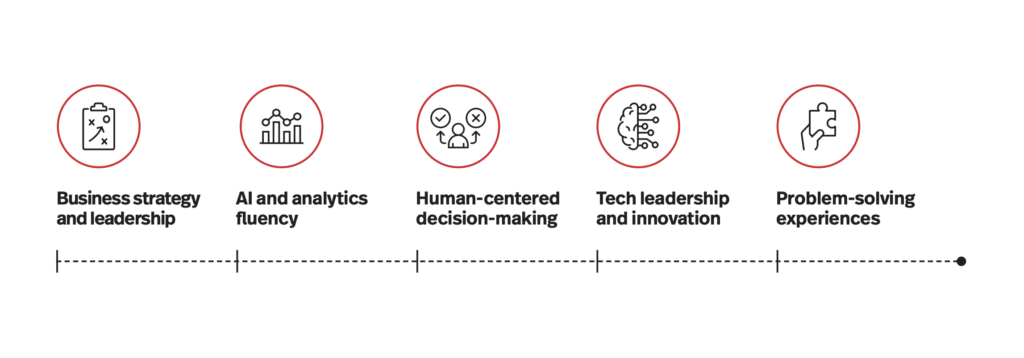
If you're looking to lead at the intersection of business and technology, the AI MBA curriculum provides the specialized knowledge and leadership skills to prepare you for that role. Alongside a strong MBA foundation, you'll develop technical fluency in AI and analytics while learning how to apply those tools to solve complex business challenges.
This approach is reflected throughout the D'Amore-McKim AI MBA courses. Courses such as Leading in the Tech Revolution develop the skills to manage organizational change and guide teams through AI-driven transformation. Competing in the Age of Smart Machines explores how emerging technologies are reshaping competitive strategy and how organizations can respond effectively. Together, these courses prepare students for the leadership demands of an AI-powered economy.
Graduates are prepared for opportunities across fast-growing industries, including:
- Data analytics
- Cybersecurity
- Technology consulting
- Engineering and operations
- Product strategy
- Digital transformation
This program prepares professionals for positions at the intersection of business strategy and technology, including roles such as AI and technology strategist, data scientist, management consultant, and operations leader. These are just a few of the careers you can pursue with an AI MBA.
Because the program can be completed in as little as one year, you can return to the workforce sooner while gaining specialized expertise in AI, analytics, and technology leadership.
Ready to explore what the AI MBA can unlock for you?
Prepare to lead in an AI-powered business world with Northeastern University's D'Amore-McKim School of Business.
Connect with the admissions team, register for an event, or start your application today to learn how the AI MBA can help you achieve your goals.
Key takeaways:
- AI fluency is becoming a core business leadership skill, helping professionals connect emerging technologies to strategy, innovation, and decision-making.
- As AI capabilities expand, uniquely human strengths like empathy, ethics, communication, and judgment become even more valuable for leaders.
- Northeastern's AI MBA combines advanced AI and analytics education with human-centric leadership development for the modern business landscape.
- Experiential learning opportunities help students apply AI to real business challenges while building practical leadership and problem-solving skills.
Explore Related Articles

Is an accelerated MBA right for you? Here's what to know
Looking to accelerate your career? One-year MBA programs are rising in popularity and D'Amore-McKim's AI MBA is a standout option for tech‑driven, analytically minded learners.

What is an MBA in AI?
Ready to lead? Earn an MBA in AI to blend advanced business expertise with practical AI know-how, giving you the confidence to lead the future.

Careers in AI: Explore the jobs you can get with an AI MBA
Achieve roles in data science, tech strategy, operations management, and more through an accelerated, future-focused AI MBA.
Connect with Admissions
Request More Information
Our graduate programs are specifically designed to meet the needs of students and professionals in this fast paced and changing global economy. Sign up to receive more information about the program that interests you most.