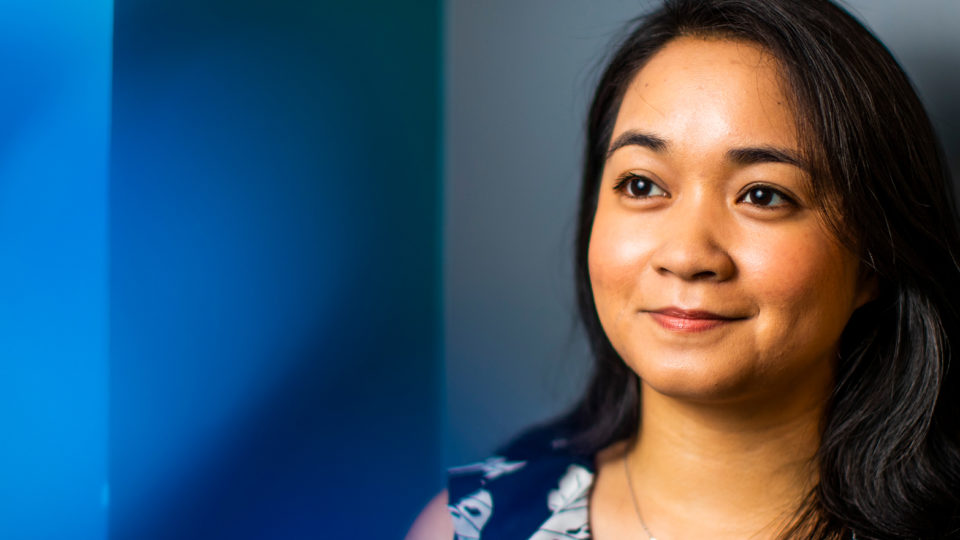
About Y-Lan
Previous University: City College of New York
Undergraduate Degree: Biology
Q: What was your background before pursuing your graduate degree?
A: Before coming to Northeastern, I spent a few years working in academic research—most recently in a conservation biology lab in New York City. I enjoyed the work, but I realized research wasn't where I wanted to build my career.
In 2016, I co-founded a startup called VeriPad. We developed a smartphone app and chemical test pad to help combat the global spread of counterfeit medication. Our vision was to become a trusted authority in identifying fake medicines and improving access to quality healthcare. That experience not only deepened my interest in pharmaceuticals and healthcare. It also sparked a real curiosity about the business side of things. That's what ultimately led me to pursue an MBA.
Q: How did your experience with the startup you founded inspire you to pursue an MBA at D'Amore-McKim?
A: Unfortunately, there's a high prevalence of counterfeit and substandard medicines in developing countries. A lot of people don't have access to high-quality medications or even to a licensed pharmacist.
My co-founders and I are all from immigrant families—I'm a first-generation American, and I come from a Vietnamese immigrant family. We did the majority of our work in Kenya, and found that many people there receive medication that is either not the correct dosage or not the concentration they require.
As a result of what we experienced, we used the startup to help people in developing countries. The app technology identifies medicine components and interprets the results for you, so you don't need a chemistry background to understand it. We wanted to impact patients who don't have the luxury of living near a pharmacy. That's what inspired us, and that's what really drove us.
Northeastern initially caught my eye because many of its programs focus on social impact. That's really important to me, so I appreciated that Northeastern provided resources for those who are interested in social initiatives.
I was also attracted to Northeastern's big healthcare and pharmaceutical network. Furthermore, Boston itself as a city has a lot of pharmaceutical companies. It's an epicenter of Biotech. Because of those aspects, I realized that D'Amore-McKim would be a great fit for me.
Q: How did you adjust to the MBA program with little prior business experience?
A: Many of the graduate students here are currently changing careers. Northeastern is good at bringing in people with various interesting backgrounds to solve different problems and meet challenges together.
Many other business programs tend to attract people from similar backgrounds. But with D'Amore-McKim, students don't just have finance backgrounds—they're people who've worked with nonprofits, with hospitals, or even the U.S. Army. Everyone here is so different. I think that really helped make me feel at home.
Q: How did D'Amore-McKim help you achieve your career goals?
A: While studying at D'Amore-McKim, I was hired for a one-year corporate residency at Biogen. I largely credit that success to the D'Amore-McKim Graduate Career Center, since they were so great at getting me through the application process. They worked with each of us individually and matched us according to what our envisioned career paths looked like.
I knew I wanted to stay in healthcare and pharmaceuticals, and I worked with the Graduate Career Center to apply for jobs in that industry. The Graduate Career Center gave me advice on what my cover letter and resume should look like. They provided interview sessions and hired a consultant to come in for mock interviews. They guided me throughout the entire process and gave me the individual attention I needed.
Q: How were you able to apply your learnings to your role at Biogen?
A: During my corporate residency, I gained a clearer understanding of how the pharmaceutical industry works. I worked with the customer market insights team, and a large portion of my role was in market research. The classes I took in the Full-Time MBA program really helped me, as I had familiarity with some of the common and basic frameworks I should follow for market research. I knew how to move beyond raw data to really see trends, and I knew how to give actionable insights and recommendations to a company to help them meet their business goals.
D'Amore-McKim challenges you to look beyond just numbers—to bridge that gap between the numbers and the action. During my residency, I got used to understanding the context behind data and recognizing how it aligns with business objectives, as opposed to just viewing data in a vacuum.
Q: What is next for you after you graduate?
A: My corporate residency at Biogen helped me make great connections. I still talk to my manager and my coworkers. They all have referred me to certain positions within the company, and we talk about what the best fit could be for me in the industry. These relationships really matter to me. My long-term goal is to be a strategic leader in pharmaceuticals, whether it's for a certain treatment, brand, or technology. There are many facets to healthcare, and I hope to oversee all of them and create actionable strategies.
Q: What would you tell students who are considering a Full-Time MBA program or a career in pharmaceuticals?
A: Network as much as possible. I know that sounds like such a cliché, but… if you know one person from one company, they probably have worked or know someone in another, and it's really important to use your network to help you pursue new opportunities.
In pharmaceuticals, career growth is based on trust. Companies try to hire people that are patient-focused. So, if you're motivated, make sure that people in this industry know that about you.
Lastly, try to use all the resources that the Graduate Career Center and D'Amore-McKim provide. They're there for a reason—to help you grow.