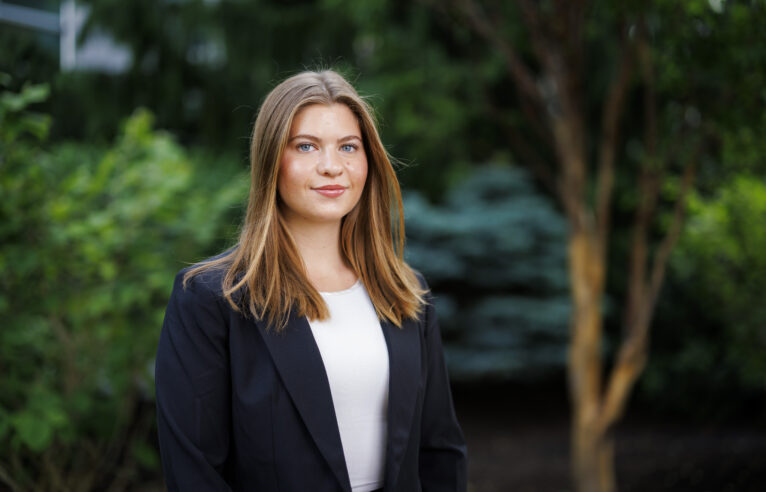
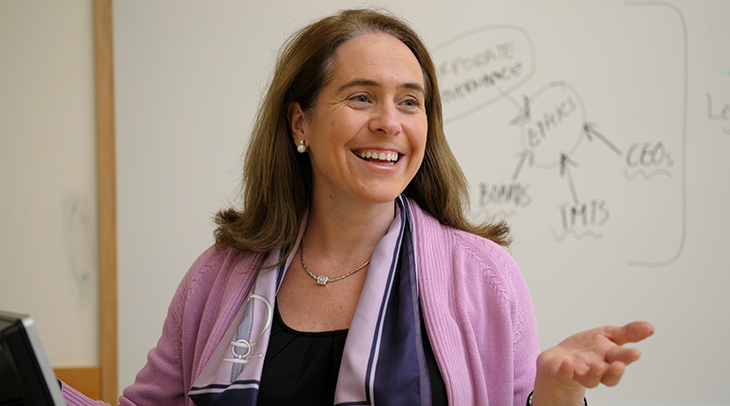
For Kate Ashley, Associate Teaching Professor and D'Amore-McKim's new Associate Dean of Graduate Education, teaching has never been simply about explaining a concept and moving on to the next one. It's about helping students see a connection between what they're learning and the problems they may one day be asked to solve.
That approach has shaped her career at D'Amore-McKim. Over the years, she has become known for making quantitative subjects more approachable, connecting classroom concepts to real business challenges and creating an environment where students feel comfortable asking questions. Her commitment to that work has earned her the school's Best Graduate Teaching award three times, the maximum number of times a faculty member can receive the honor.
Her interest in teaching began long before she entered academia. Ashley remembers tutoring others throughout high school and college, and she eventually pursued a PhD with the goal of becoming a professor. Along the way, she spent time in consulting, an experience that exposed her to different organizations and their problems and helped shape her interest in operations and supply chain management.
That interest was also influenced by where she grew up. Ashley was raised on Dancing Bear Farm, an organic vegetable farm in Western Massachusetts. Watching the farm operate and thinking about everything required to get a product from the field to a customer gave her an early, practical connection to operations.
“I've always been fascinated by how things work,” Ashley says. That curiosity eventually became an academic career focused on helping others understand those systems, too.


Making numbers matter
One of Ashley's biggest challenges as a teacher is also one of her biggest opportunities: helping students who don't necessarily see themselves as “quantitative” become comfortable working with numbers, statistics, and analytical problems. Her solution isn't to make the material simpler. It's to make it relevant.
She uses real-world examples, group activities, discussions, industry projects, and guest speakers to give students opportunities to see how the concepts they are learning apply beyond the classroom. In her capstone course, for example, students spend an entire semester working on a substantial industry project. The goal is not simply for students to arrive at the right answer. “I want them to understand why they're doing what they're doing,” she says.
That distinction has become increasingly important as technology changes the way analytical work gets done. Ashley believes students need to understand the tools available to them, including AI, but they also need the judgment to question the results those tools produce.
“You have to understand what you're asking the tool to do,” she says. “And you have to be able to look at the answer and say, ‘Does this make sense?'” For Ashley, that is where teaching quantitative subjects becomes less about formulas and more about developing confidence and judgment.
The moment it clicks
One of the experiences Ashley remembers most vividly involved an undergraduate industry project built around an enormous optimization problem. The students were working with a real company and faced a problem involving more than 100,000 decision variables.
For students who had never tackled anything of that scale, the assignment initially felt overwhelming. But after spending the semester developing their approach, working with the data, and building their model, they eventually reached the moment when they could ask the system to solve the problem. And it worked.
Ashley remembers seeing the students' reaction as the solution appeared. They had started the project unsure whether they could handle it. By the end, they had solved a problem that initially seemed far beyond their reach.
“That's the moment you want,” she says. For her, those moments explain why teaching remains so rewarding. The most important outcome isn't necessarily that students remember every concept from a course. It's that they leave believing they can tackle something difficult.


A bigger opportunity to serve students
Now, Ashley's role as Associate Dean of Graduate Education gives her an opportunity to bring that same philosophy to an even broader group of students. Rather than working primarily with the students enrolled in her own courses, she can help shape the graduate experience across D'Amore-McKim's programs, from the curriculum and student experience to the skills graduates will need as the business landscape continues to change.
It's a responsibility she approaches with the same question she brings into her classroom: What do students need, and how can we help them get there?
Graduate education is changing quickly. New technologies are reshaping the workplace, employers are looking for different combinations of technical and human skills, and students increasingly want educational experiences that connect directly to their careers. Ashley sees her new role as an opportunity to listen closely to those needs and help D'Amore-McKim continue evolving. “I want to make sure we're giving students what they need to be successful,” she says.
That doesn't mean leaving the classroom behind. Teaching remains central to how Ashley thinks about her work, and she hopes to carry the lessons she's learned from years of working directly with students into her leadership role.
If there's one thing she wants students to remember about their time with her, it's that she cared. “I hope they know that I was passionate about what I was teaching,” she says.
That may be the throughline of Ashley's career: making complicated things feel possible. Whether she's helping a student understand an unfamiliar statistical concept, guiding a team through a complex optimization problem, or thinking about the future of graduate education, her focus remains on helping people understand not only how something works, but why it matters.