


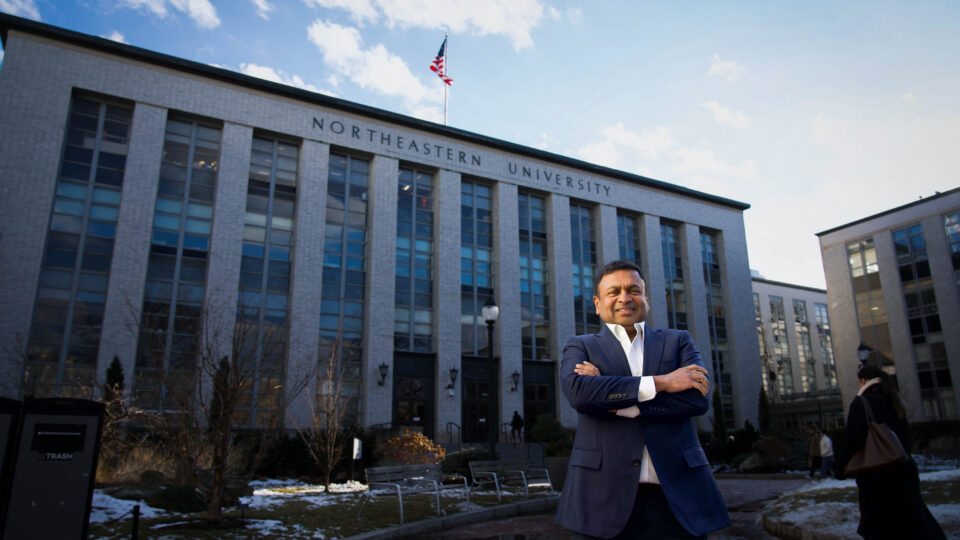
When Rajesh Aggarwal arrived at college, he didn't expect finance to define his career. The Donald F. Harding Distinguished Professor of Finance was fascinated by how governments functioned and how markets shaped society, initially considering political science or philosophy before discovering economics. What drew him in wasn't just business; it was the discipline's ability to explain complex problems through rigorous analysis.
“I was always kind of interested in how the world worked,” Aggarwal says. “I found the formal mathematical structure of economics much more concrete than pure verbal descriptions.”
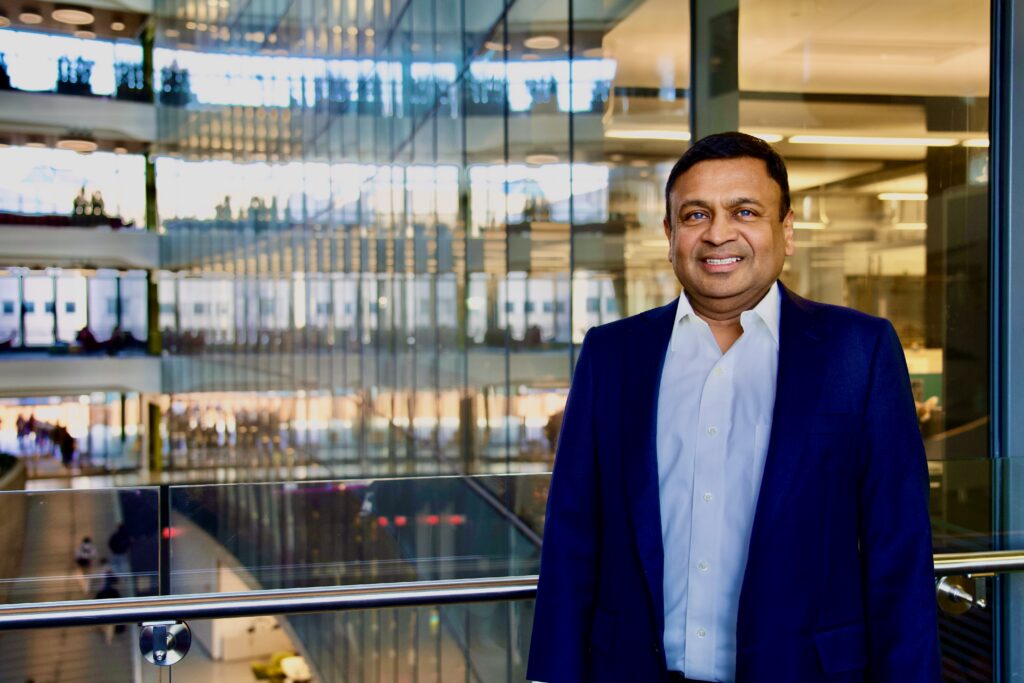

Like many economics students, Aggarwal saw Wall Street as the obvious next step. Then history intervened. During the stock market crash of 1987, he was taking a finance course taught by Robert Shiller, who would later receive the Nobel Prize in Economic Sciences. After discussing the crash with his professor, Shiller offered advice that would alter the course of Aggarwal's career: “If you really want to think deeply about financial markets and things like why the stock market suddenly crashes, you might want to go get a PhD.” “That was the inspiration for me,” Aggarwal recalls.
That conversation launched a career spanning consulting, research, teaching, and academic leadership at leading institutions including the University of Minnesota, the University of Virginia, the University of Michigan, Oxford University, and Dartmouth College before bringing him to Northeastern.
Looking beyond conventional wisdom
Throughout his career, Aggarwal has been drawn to questions that challenge accepted assumptions. For instance, early in his research, many scholars believed executive pay wasn't closely tied to company performance. Aggarwal wasn't convinced.
“It seemed counterintuitive to me,” he says. “Something was missing.”
His research revealed that company risk was the missing ingredient. Once risk was taken into account, the relationship between executive compensation and company performance became much clearer, helping reshape how researchers thought about incentive structures inside organizations.
From there, his interests expanded into broader questions of corporate governance and financial markets. He examined mergers and acquisitions, explored how stock prices can be manipulated despite conventional theories suggesting otherwise, and identified the conditions that enable market manipulation, particularly when investors can convincingly present themselves as having privileged information.
More recently, Aggarwal's work has focused on the intersection of finance, public policy, and innovation. His research on H-1B visa restrictions found that while large corporations can relocate research and development overseas when access to skilled workers becomes limited, smaller companies often cannot. The result is fewer startups able to scale, more concentrated markets, and ultimately higher prices for consumers.”We're actually paying a lot more day-to-day for goods and services,” Aggarwal says.
Despite the wide range of topics, Aggarwal says his research has always followed the same philosophy. “I've always been guided by whatever was interesting to me at the time.”
Bringing research into the classroom
While his scholarship has influenced the field of finance, Aggarwal believes research and teaching are inseparable. “I view teaching and research as synergistic,” he says. “There's just a great complementarity there.”
Current research frequently becomes classroom discussion, allowing students to examine real-world issues as they unfold—from immigration policy and financial markets to artificial intelligence and corporate strategy.
At the same time, students continually sharpen their own thinking. “A really good classroom discussion… can lead to some really interesting unanswered questions,” Aggarwal says.
His consulting work has also enriched the student experience. Throughout his career, Aggarwal has advised organizations on topics ranging from mergers and acquisitions to investment management, bringing those real-world experiences back into the classroom. One example came when Massachusetts officials asked him to analyze Procter & Gamble's acquisition of Gillette. He later turned that experience into a classroom case study, giving students an inside look at one of the business world's most significant mergers and the strategic decisions unfolding behind the scenes.
Leading a business school through change
In addition to his scholarship, Aggarwal has helped shape D'Amore-McKim through leadership, serving as deputy dean for two years before stepping in as interim dean during the first half of 2026. His leadership philosophy mirrors the way he approaches research: stay connected to what's happening in the world.
“Business schools have very, very direct connections to practice and to what is actually happening in the economy and in industry,” he says.
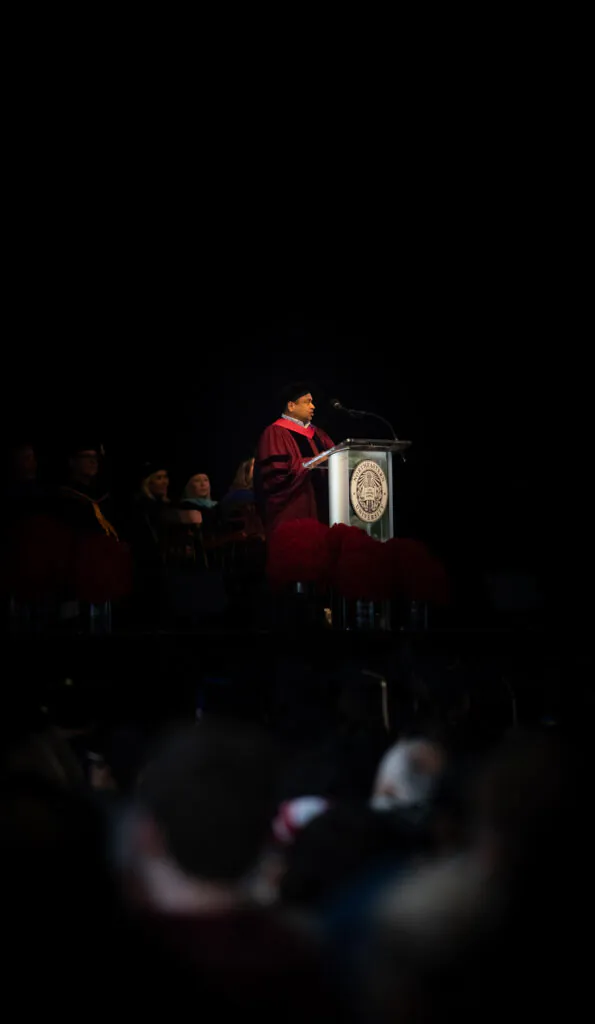
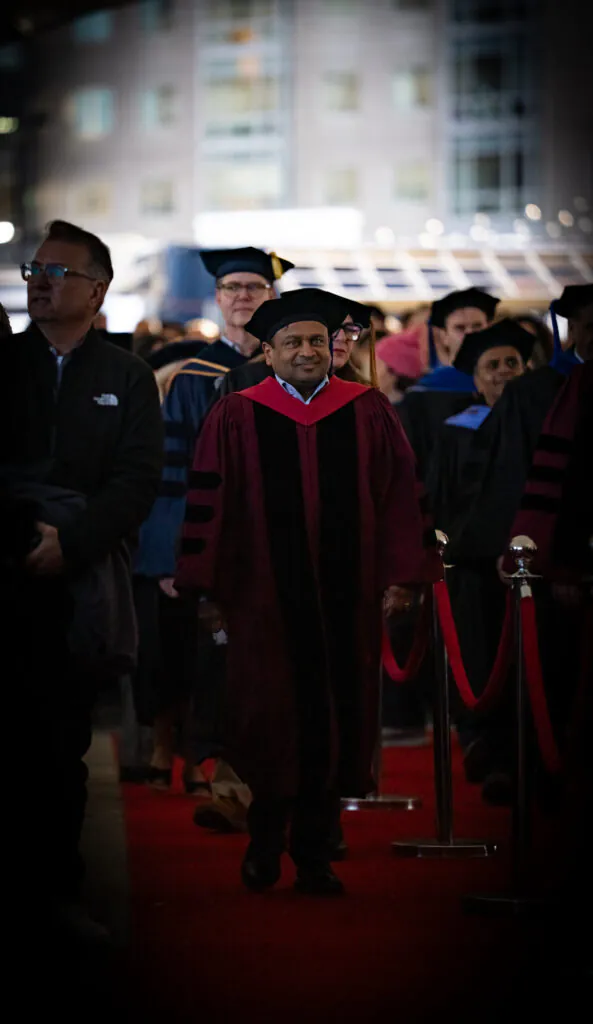
That means constantly evolving alongside business itself—from artificial intelligence and cryptocurrency to the space economy and hybrid work. “Business schools have to innovate to be able to stay current,” he says. “Our scholarship can be pretty impactful.”
For Aggarwal, that ability to adapt is what distinguishes a great business school. Whether at Oxford, where he witnessed the launch of a new business school, or at Northeastern, he has seen that institutions willing to embrace innovation are the ones best positioned to prepare students for the future.
Lessons that last
Some of his most meaningful lessons didn't come from research; they came from mentors. Early in his career, a senior colleague made a habit of taking him out for coffee each afternoon, reminding him that academia offered something rare: the freedom to explore ideas that genuinely mattered.
Years later, Aggarwal finds himself thinking less about publications and more about the students who stayed in touch after graduation. Many have gone on to become CEOs, hedge fund managers, and business leaders. “I wasn't responsible for their success in any way, but they did remember lessons or things we talked about… We do have an impact on our students,” he says.
A mentor also shared one piece of advice that still shapes every class he teaches. “When you're in the classroom, make certain you're always having a good time,” Aggarwal says. “If you're having a good time, they'll be into it.”
After decades of research, teaching, and leadership, he hopes his impact is measured not only by the questions he answered, but by the people he helped inspire. “I hope my students have learned something from my classes, that it's inspired them, it's gotten them to think differently, and hopefully helped them go on and do great things. Hopefully we move things a little bit in the right direction.”