



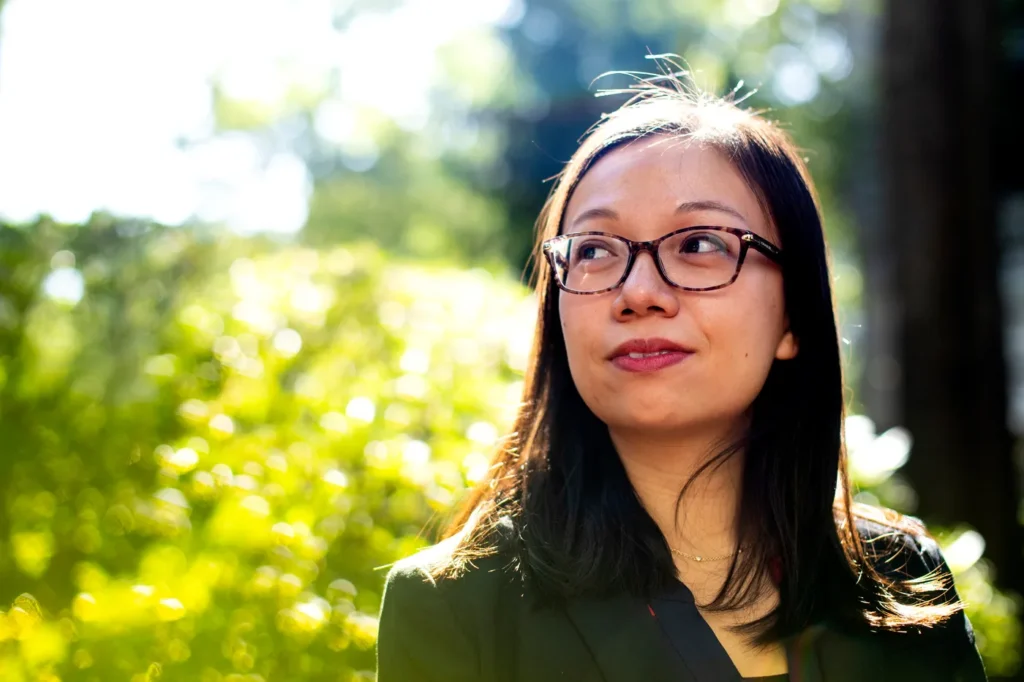
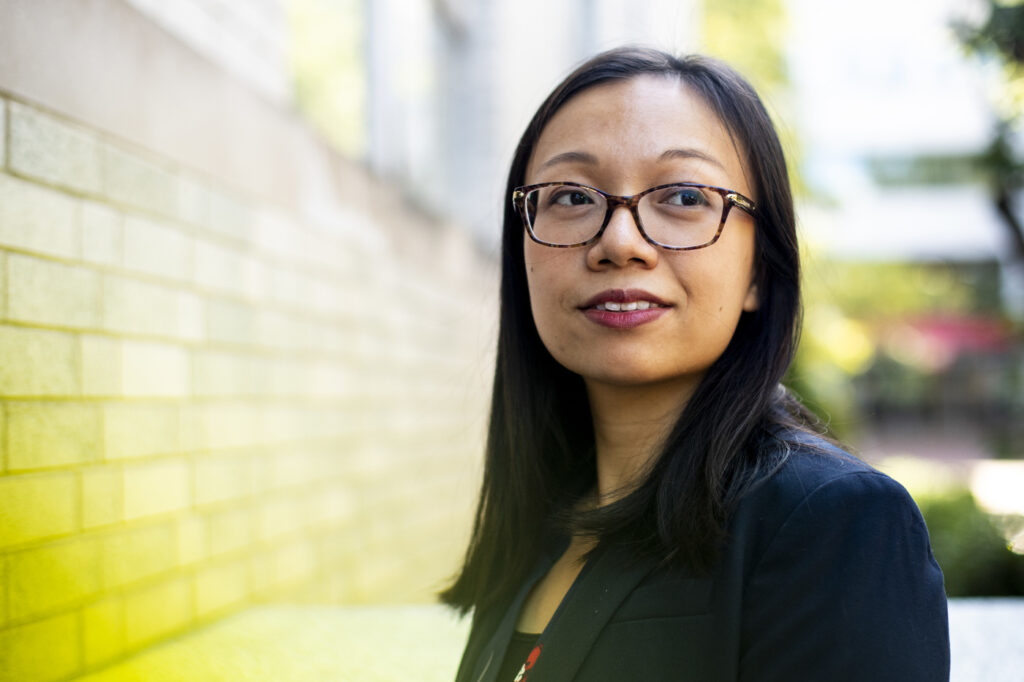
When Assistant Professor Weiling Liu looked at the syllabus for FINA 4350-Applied Financial Econometrics and Data Modeling, she saw a course that was doing its job but not preparing students for the one they would land. The class had long relied on Excel and R to teach financial modeling. Both are capable platforms, but neither reflects what employers in fintech and quantitative finance now expect new hires to know. So, Liu set out to close a gap that many of her students had not yet realized existed.
The redesigned course, which sits at the intersection of mathematical modeling, programming, and finance, now runs on Python and Jupyter Notebooks and introduces students to machine learning methods applied to real financial data. Its official catalog description, which details analytical tools for examining time-series data in financial econometrics, only hints at how much the experience has changed under Liu's direction.
One of Liu's sharpest observations about the course is how unevenly students arrive because FINA 4350 draws on three distinct skill sets: math, coding, and finance, and almost every student walks in strong in one area and shaky in another. Liu has watched a talented programmer learn what a stock option is for the first time by building the models that price them. She has seen a finance student who had never opened a Jupyter Notebook grow comfortable writing Python scripts by semester's end. The course, in other words, does not just teach. Rather, it fills in the blank spots that a traditional curriculum can leave behind.
Liu is careful to distinguish between students who can execute a model and those who can interrogate one. Roughly half of each class session is devoted not to building but to questioning and examining whether a model's output makes intuitive sense and probing its assumptions. A recent addition to the syllabus is a crash course on hyperparameter tuning and cross-validation, tools that guard against overfitting and underfitting plaguing data-heavy disciplines. Students first learn the theory, then apply it in Python to models they have constructed themselves. When the class builds ARMA models, for instance, they use cross-validation to determine the optimal number of autoregressive lags through sample testing, turning an abstract statistical concept into a practical skill.
Real-World Ripple Effects
The impact of Liu's teaching extends well beyond the final exam. Last summer, she reconnected with alumnus Lucas Coelho, DMSB‘23, and provided guidance that helped him gain admission to Georgia Tech's Master's in Business Analytics program. In one of their conversations, Coelho reflected on what he took away from Liu's earlier course, FINA 2201, noting that he now invests in U.S. Treasury Bonds, something he says he never would have considered before her class.
For Liu, moments like these reinforce broader ambition. The redesign has made her think more deliberately about how the statistical tools taught in her classroom can serve students not only in their careers but in managing their own personal wealth. With Python and Jupyter Notebooks freely available, she sees an opportunity for young people to write code that helps them better predict and understand market returns on their own terms.
The AI Question
Liu is already thinking about what will come next. Toward the end of the most recent semester, some students began using AI to brainstorm stock picks for their portfolios, but when a few tried to hand off the coding of their final projects to AI tools, the results fell apart. They lacked the coherence that comes from actually understanding the models underneath. It was a telling preview of tension that will only grow.
Looking five years out, Liu envisions a version of the course that teaches students to code efficiently with AI assistance and to use it as a brainstorming partner for ideas like new investment opportunities. But she is equally insistent that students learn the economics and intuition behind every model output. Without that foundation, she warns, AI-generated financial models become liabilities rather than assets.
Liu's work on FINA 4350 earned her the 2026 Rupert Teaching Innovation & Excellence Award–a recognition that speaks to the ambition and care she has brought to a course that could easily have remained a conventional econometrics offering. Instead, it has become a place where students learn to think like the quantitative professionals the industry is actually hiring: fluent in Python, skeptical of their own models, and ready to navigate the opportunities and pitfalls of AI in finance.