


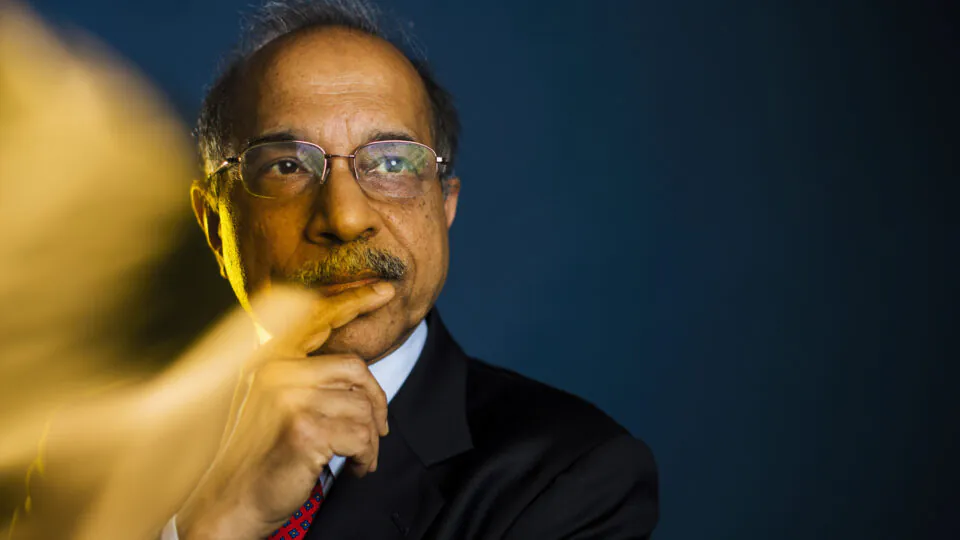
For much of his career, Ravi Ramamurti has posed a question that once was largely ignored by American business schools: What about the rest of the world?
When he arrived in the United States from India nearly 50 years ago to pursue his doctoral studies, international business was already his chosen field. However, within that field, his curiosity was strongly drawn to countries that rarely received attention in U.S. classrooms. At the time, case studies and research papers mainly focused on North America, Western Europe, and Japan. The economic lives of billions in Asia, Africa, and Latin America were regarded as secondary, and he felt this was a mistake.
D'Amore-McKim School of Business University Distinguished Professor of International Business and Strategy and Director of the Center for Emerging Markets Ravi Ramamurti grew up in India, where poverty was a daily reality. The government was not distant; it played a major role in the economy. State-owned enterprises produced goods, managed infrastructure, and aimed to address social and developmental issues. After earning his MBA, Ramamurti chose to work for the Indian government despite attractive offers from the private sector. Later, he became an executive assistant to the CEO of a large state-owned enterprise. These experiences left a lasting impression: while these organizations were key to the country's development, many faced challenges with performance and accountability.


When Ramamurti started his doctoral studies, many questions followed him. How can state-owned enterprises be managed more effectively? Can public sector organizations achieve better economic results? In his first decade as a scholar, Ramamurti focused on examining those exact issues.
In the United States, the topic was not particularly of interest. The U.S. economy had relatively few state-owned firms, and the management of public enterprises seemed disconnected from mainstream corporate concerns. However, outside the U.S., the topic was urgent. Across Asia, Africa, and parts of Europe, state-owned companies dominated key industries. For Ramamurti, studying them was not just an academic curiosity but a way to engage with the economic realities facing most of the world's population.
“I came from India and realized these countries were not getting much attention,” Ramamurti says. Even at elite institutions, only a handful of faculty members focused on what some considered “strange places.” He gravitated toward them, sensing that the center of gravity in global business would not remain a fixed constant forever.
Following the world as it changed
His research career unfolded in distinct chapters, each lasting about a decade and shaped by changes in the global economy. In the late 1980s and 1990s, the policy environment began to shift. Governments worldwide started privatizing state-owned enterprises and deregulating industries. Instead of trying to reform public firms internally, policymakers increasingly turned to market competition to boost efficiency and growth.
Ramamurti adapted his research accordingly. Instead of focusing only on fixing state-owned enterprises, he began studying privatization and deregulation. With support from institutions such as the World Bank and the United Nations, he examined how countries implemented reforms and what outcomes followed. The work required navigating policymakers, accessing sensitive data, and understanding the political economy behind reform efforts. Eventually, Ramamurti served as the World Bank's chief consultant for a review of its privatization strategy.
For Ramamurti, research was always connected to his lived reality. His prior experience in government and industry gave him credibility and access. As a consultant to global institutions, he could shape the questions asked of national governments and, in turn, gather insights that informed both academia and policy. Ramamurti's unique profile led to visiting professor appointments at Harvard Business School, MIT-Sloan, and Wharton, among others, but D'Amore-McKim remained his permanent home.
By the 2000s, another shift was underway. Companies from emerging markets such as Korea, India, China, and Brazil, were no longer confined to their home economies. They were expanding abroad, acquiring firms, and competing with established multinationals. Ramamurti devoted his third decade of research to these “emerging market multinationals.”. How did firms from relatively poorer countries manage to compete globally? What capabilities enabled them to succeed in international markets? The answers, he found, often lay in innovation.
That realization shaped his fourth major research focus. He turned to studying innovation in emerging markets, including the phenomenon of “reverse innovation”: ideas and products developed in poorer countries that later diffused to wealthier ones. What once seemed counterintuitive is now common, as innovations originating in China or India often set global standards. Across these evolving themes, a consistency runs through Ramamurti's journey: the belief that the world's economic dynamism would increasingly come from places once regarded as marginal.
Ending a “double life”
For many years at D'Amore-McKim, Ramamurti has described himself as living a “double life.”
In the classroom, he taught traditional international business topics that often centered on developed markets. In his research and consulting, he immersed himself in emerging economies. However, the two worlds did not fully overlap. He could introduce examples from emerging markets in lectures, but spending too much time on them risked losing students' interest, who expected a more conventional syllabus.
Over time, that divide narrowed. As emerging markets became central to global supply chains, capital flows, and geopolitics, they could no longer be treated as side notes. This convergence allowed Ramamurti to integrate his research directly into his teaching. What had once felt like a balancing act became a unified life.
The culmination of that shift came in 2007, when he founded Northeastern's Center for Emerging Markets. Ramamurti's goal was both strategic and symbolic. International business was already a strength at D'Amore-McKim, so it only made sense to establish the center as a leader in the study of emerging markets.


The early years were testing. The center had little funding and limited administrative support. Ramamurti charged forward through changes in university leadership and resource constraints, steadily building momentum. Over time, the center assembled a network of faculty associates, today exceeding 70 from across the university – roughly half from D'Amore-McKim and half from other Northeastern colleges. He also created an advisory board composed of CEOs and senior executives of multinational corporations and major firms operating in emerging markets that he met in the course of his work. The board not only provided guidance but also brought real-world perspectives into the university through events and campus visits.
In 2022, the center secured approval to hire a full-time program manager, expanding by leaps and bounds its capacity to serve students. What began as a faculty-driven initiative focused on research has evolved into a multifaceted hub supporting research, practitioner engagement, and student development.
Today, the center organizes research conferences and seminars supported by the Nardone family. Its largest initiative, made possible by an endowed gift from Vivek and Vandana Sharma, supports India-centric lectures, summits, and research. For students, CEM offers a minor in emerging markets, student associate and fellowship programs within CEM, funding for immersive projects abroad through the Srinivasan Family Awards, Revvity Foundation scholarships for students from emerging economies that include the opportunity to shadow a C-suite executives at the company, and a new DiSanto award that gives up to 10 students a fully-funded week-long program in Washington DC on corporate diplomacy. Hundreds of students participate in CEM's events and programs each year.
When asked about his greatest accomplishment at Northeastern, Ramamurti points to the Center for Emerging Markets without hesitation. It represents years of persistence and a belief that the school could help shape how emerging markets are understood and impacted. “It wouldn't have been possible,” Ramamurti says, ” without the generous help and support of Northeastern University colleagues, friends, and well-wishers.
Learning with students
If research has been one pillar of Ramamurti's career, teaching has been the other. The University Distinguished Professor has taught undergraduates, MBA students, and executives, including serving as faculty co-director of the Executive MBA program. For many years, he worked primarily with experienced professionals who brought 15 or more years of industry insight into the classroom.
One pillar of Ramamurti's executive teaching was immersive global study trips. Students would spend time at corporate headquarters in the United States, meeting senior leaders and dissecting strategy. Then they would travel abroad to places such as Hong Kong, Shenzhen, and Shanghai to see how those strategies played out in practice. They would meet a CEO in Pawtucket one week and then tour factories in China the next. The goal was to bridge the gap between theory and practice. In those settings, Ramamurti says, he was learning alongside his students.
For Ramamurti, education is more than just transferring knowledge. It's about cultivating judgment—the ability to act amid ambiguity, uncertainty, and incomplete information. He tells students that two qualities are essential: a global mindset and the skill to make sound judgments in uncertain conditions. The first requires exposure and curiosity, while the second requires practice and a tolerance for complexity.
His professional life unfolded during what he describes as a golden era of globalization, or decades characterized by expanding trade, institutional cooperation, and relatively stable geopolitics. From the mid-20th century through roughly 2010, integration appeared to deepen year after year. That era, he believes, is giving way to something more turbulent.
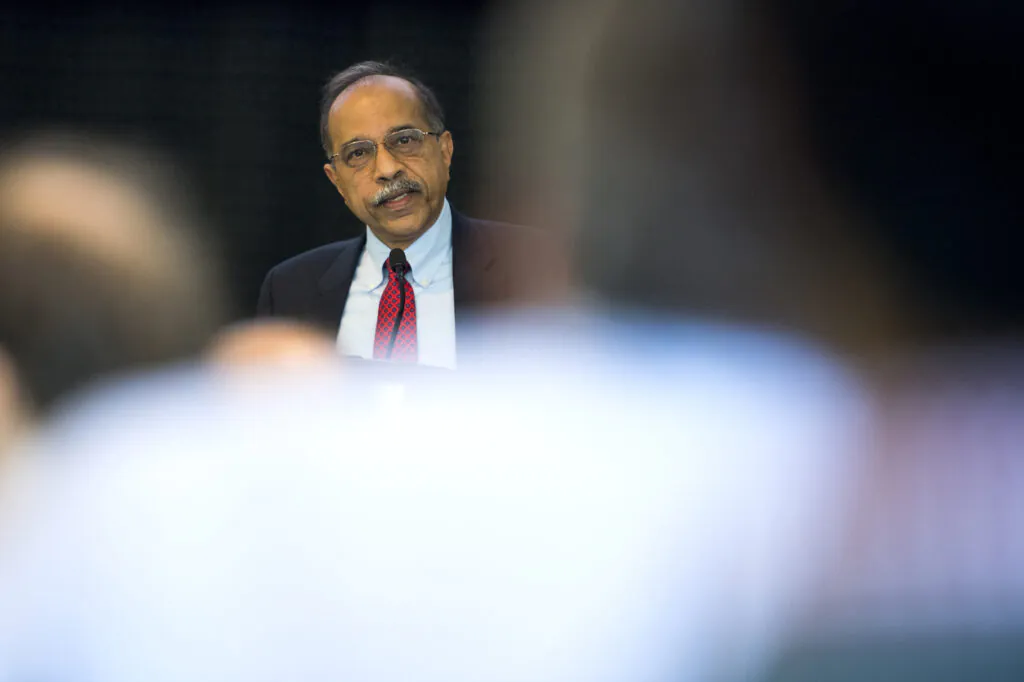

Ramamurti predicts the end of hyper-globalization and the rise of a more fragmented international system, in which geopolitics, national interests, and demographic shifts play a larger role. Slowing population growth, U.S.-China rivalry, and climate change introduce layers of uncertainty that companies and policymakers cannot ignore. For students entering this environment, the path will be less straightforward than it was for previous generations. Careers may last longer and require multiple reinventions. Ramamurti believes understanding “megatrends,” the large, persistent forces shaping the global landscape, is essential.
He credits his own career to having aligned with one such megatrend: the rise of emerging markets. Rather than fighting the current, he embraced it. Future leaders, he suggests, must be equally attentive, prepared to adjust as one wave settles and another forms. After decades of research, institution-building, and mentorship, Ramamurti remains curious by the same conviction that first drew him to international business, that the economic destinies of billions deserve serious study.
Once overlooked, emerging markets now dominate headlines and boardroom agendas. In many ways, the world has caught up to the questions he began asking half a century ago.