


About the Event
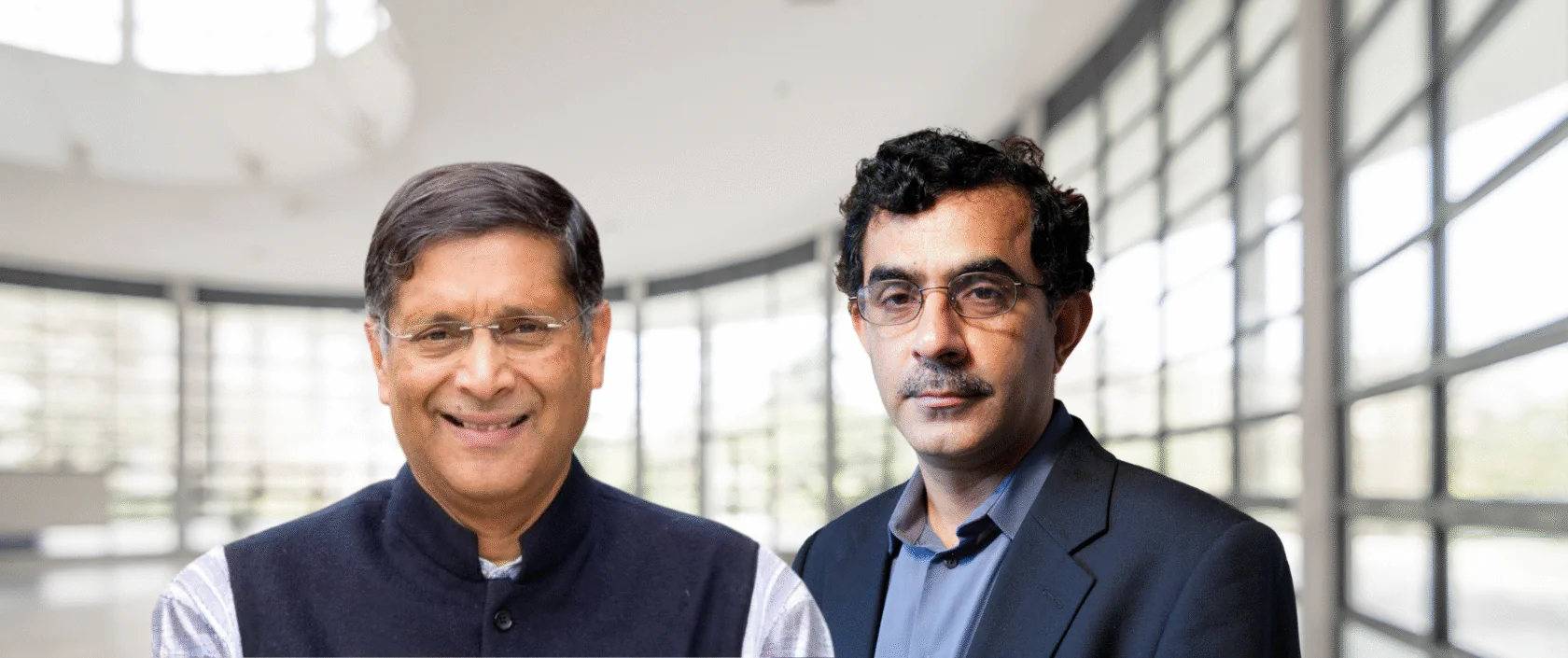
The Center for Emerging Markets welcomed Devesh Kapur, Starr Foundation Professor of South Asian Studies at Johns Hopkins University, and Arvind Subramanian, Senior Fellow at the Pearson Institute for International Economics, to discuss the distinctive economic and political path India has followed since its independence in 1947. The discussion centered around findings described in their critically acclaimed book, A Sixth of Humanity: Independent India's Development Odyssey.
About the Speakers
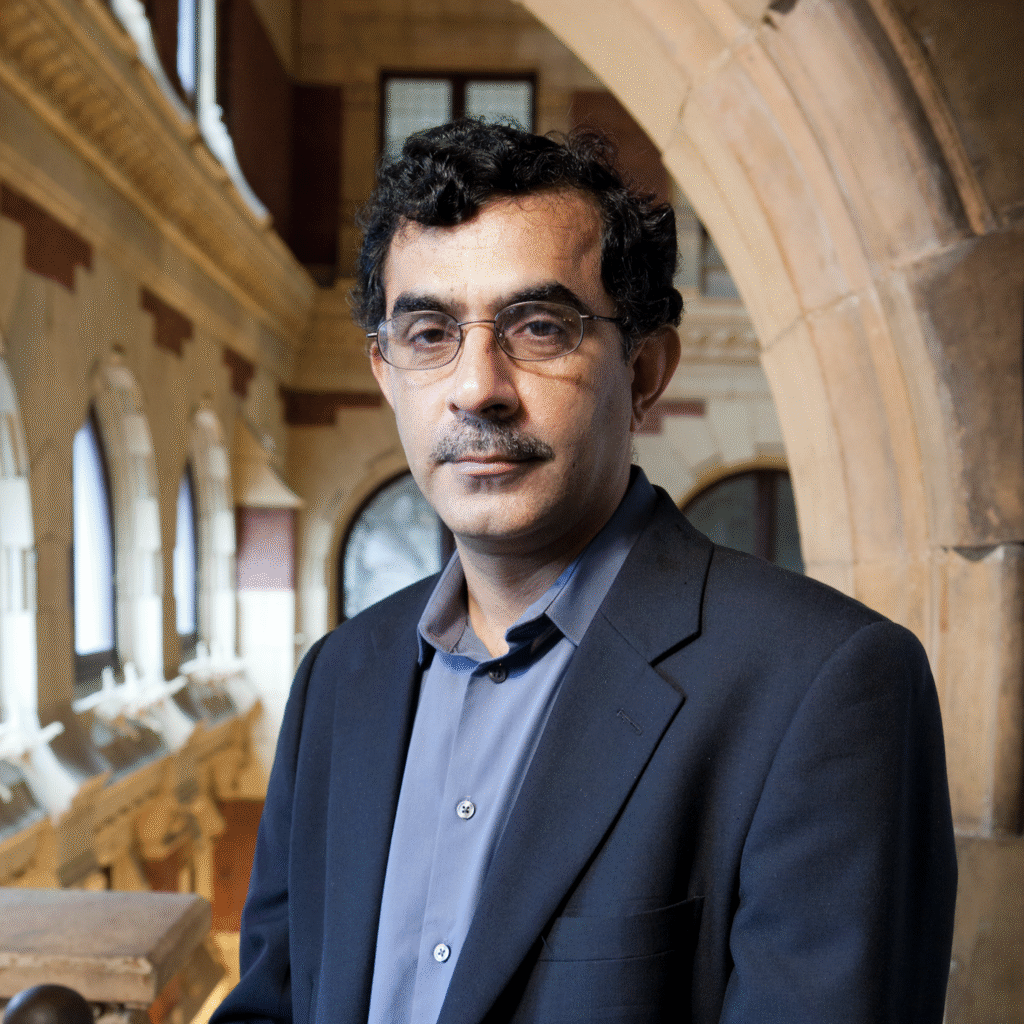
Devesh Kapur is presently the Starr Foundation Professor of South Asian Studies at Johns Hopkins University. He joined the Johns Hopkins University School of Advanced International Studies (SAIS) in July 2018 from the University of Pennsylvania, where he was a professor of Political Science and Director of the Center for the Advanced Study of India, holding the Madan Lal Sobti Chair for the Study of Contemporary India. Prior to his tenure at Penn, he was Associate Professor of Government at the University of Texas at Austin, and the Frederick Danziger Associate Professor of Government at Harvard. Kapur received the Joseph R. Levenson Teaching Prize, awarded to the best junior faculty at Harvard College and Outstanding Teaching in Political Science by the American Political Science Association, in 2005.
Kapur's research has focused on five broad areas that examine the political and institutional determinants of economic development: international financial institutions; political and economic consequences of international and internal migration; the effects of market forces and urbanization on the well-being of socially marginalized groups in India; governance and public institutions; and higher education. His book, Diaspora, Democracy and Development: The Impact of International Migration from India on India (Princeton University Press) earned him a 2012 Distinguished Book Award of the International Studies Association, while The Other One Percent: Indians in America (with Sanjoy Chakravorty and Nirvikar Singh) was a Choice Outstanding Title of 2017. His other publications include The World Bank: Its First Half Century (with John Lewis and Richard Webb) and Defying the Odds: The Rise of Dalit Entrepreneurs (co-authored with D. Shyam Babu and Chandra Bhan Prasad). His latest edited works are Navigating the Labyrinth: Perspectives on India's Higher Education (with Pratap Bhanu Mehta), Rethinking Public Institutions in India (with Pratap Bhanu Mehta and Milan Vaishnav), The Costs of Democracy: Political Finance in India (with Milan Vaishnav) and Regulation in India: Design, Capacity, Performance (with Madhav Khosla)
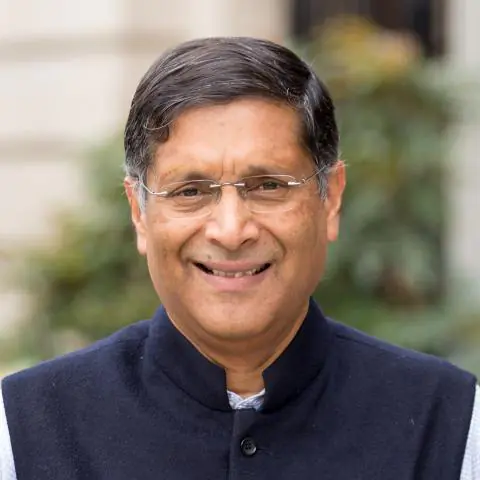
Arvind Subramanian, senior fellow at the Peterson Institute for International Economics, has been associated with the Institute since 2007. He was the Dennis Weatherstone Senior Fellow at the Institute during 2013–14 and was on leave for public service from 2014 to August 2023. Previously, he was senior fellow at the Watson Institute for International and Public Affairs at Brown University, distinguished nonresident fellow at the Center for Global Development, professor at Ashoka University, New Delhi, and visiting lecturer at the Harvard Kennedy School. He served as the chief economic advisor to the government of India between 2014 and 2018. He currently advises the government of the Indian state Tamil Nadu on macroeconomic and sectoral issues.
As chief economic adviser during 2014–18, Subramanian oversaw the publication of the annual Economic Survey of India, which became a widely read document on Indian economic policy and development. For example, the 2018 Survey had 20 million views from over 190 countries in its first year of publication. Major initiatives carried out during his tenure included a uniform nationwide goods and services tax (GST), a bankruptcy code to tackle the Twin Balance Sheet challenge, a financial and digital platform for connectivity (the so-called JAM trinity), and universal basic income schemes.
While at the Institute, Subramanian wrote two critically acclaimed books: Eclipse: Living in the Shadow of China's Economic Dominance, published by PIIE in September 2011, and India's Turn: Understanding the Economic Transformation, published by Oxford University Press in 2008. Foreign Policy magazine named him one of the world's top 100 global thinkers in 2011. He has written extensively for many academic journals on growth, trade, development, aid, India, Africa, and the World Trade Organization. His op-eds and essays have been cited and published in the Economist, Financial Times, Foreign Affairs, Washington Post, New York Times, Wall Street Journal, Newsweek, New York Review of Books, and the Business Standard, andhe is a regular columnist for Project Syndicate.
Before joining PIIE, Subramanian was the assistant director in the research department of the International Monetary Fund. He served at the General Agreement on Tariffs and Trade (GATT) from 1988 to 1992 during the Uruguay Round of trade negotiations and previously taught at Harvard University's Kennedy School of Government and Johns Hopkins School for Advanced International Studies.
About the Book
India's journey has been distinctively ‘precocious' in comparative terms. It opted for democracy before development and social change, promoted high-skilled services before and over low-skilled manufacturing and chose a globalization that favoured exports of talented people and short-changed the poor. The socialist state became an inefficiently capitalist one before providing the public goods of physical infrastructure and human capital. The outcomes have been surprising, with the country achieving success in creating and sustaining democracy, albeit flawed, and maintaining a modicum of order.
Four decades of economic dynamism and the emergence of a somewhat more capable Indian state has meant that it is able to build infrastructure and deliver the essentials of life to its population at scale-still not without disappointments, but a massive improvement over the past. Just as India's aspiration has lifted to building ‘world-class' statues, temples, bullet trains, airports and digital systems, the undermining of some of the real achievements of democracy, federalism and nation-building stand in the way.
As the world gets radically upended, India's development odyssey is at a critical juncture. A Sixth of Humanity is an attempt to trace how one of the largest and most diverse countries in the world, uniquely and daringly, attempted four concurrent transformations-building a state, creating an economy, changing society and forging a sense of nationhood-under conditions of universal suffrage.
About the Vivek and Vandana Sharma India Initiative
The Vivek and Vandana Sharma India Initiative supports programming to expand and deepen Northeastern University's engagement with economic and business issues in India. It supports CEM's India Lecture series, enables scholars, students, and practitioners from India to complete visiting terms at the CEM, encourages D'Amore-McKim and CEM faculty to conduct use-inspired research in India, and creates a community of business leaders in the U.S. and India with a special interest in American-Indian economic ties.