


Every June, monsoon season arrives in India and brings a familiar problem: streets disappear under water, trains stall, and commute times stretch into hours. For most cities, the response comes after the fact, pumping out the water, rerouting traffic, and cleaning up once the rain has passed.
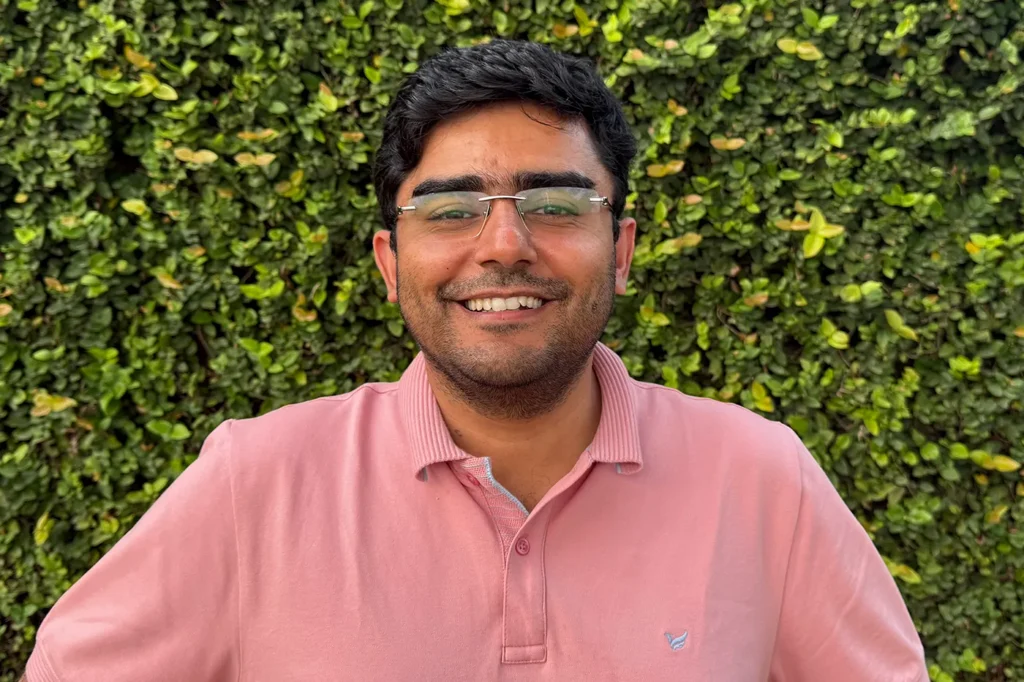
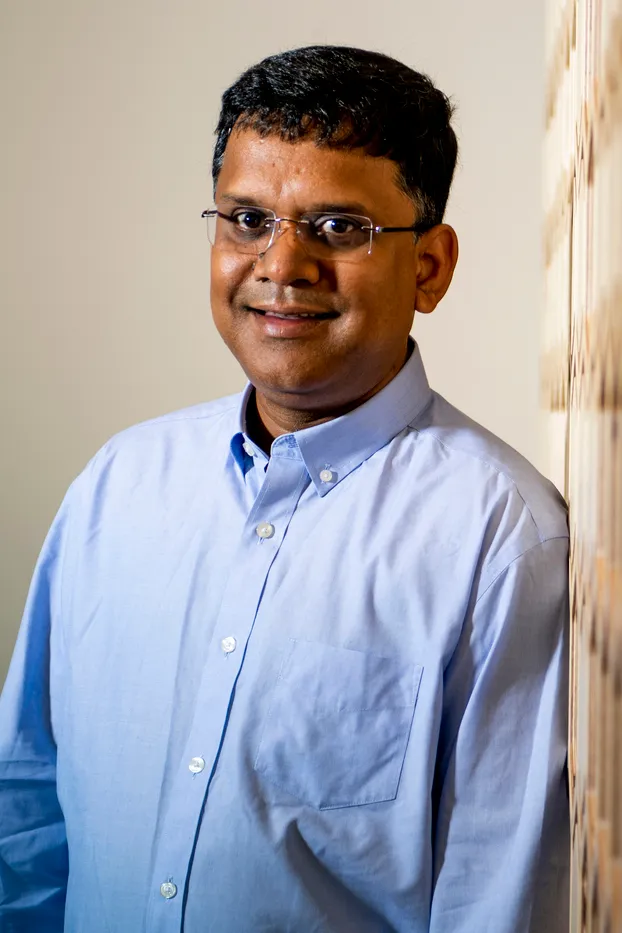
A new startup, AIResQ, wants to flip that order. Co-founded by Northeastern alum Udit Bhatia, Ph.D. ‘18, and Distinguished Professor of Civil and Environmental Engineering and Center for Emerging Markets (CEM) Faculty Fellow Auroop Ganguly, AIResQ helps cities see flood risk in real time, down to where and how deep the water will get, so they can act before it arrives.
Bhatia earned both his master's and Ph.D. from Northeastern's Department of Civil and Environmental Engineering, working in the Sustainability and Data Sciences Laboratory. He's now an Assistant Professor at the Indian Institute of Technology in Gandhinagar, Gujarat (IIT Gandhinagar), with joint appointments in civil engineering and computer science, and directs the university's AI Resilience and Command Centre, known as ARC. ARC and AIResQ grew out of the same research ecosystem at IIT Gandhinagar: ARC provides the underlying research and decision-visualization environment, while AIResQ is the IIT-incubated startup that turns that work into systems cities can actually deploy.
AIResQ layers artificial intelligence on top of physics-based flood modeling, a combination the team calls physics-guided AI. Traditional flood simulations are accurate but slow, sometimes taking days to run. AI models are fast but can produce answers that ignore how water actually behaves. AIResQ's approach keeps the AI tied to the physical rules that govern water flow, so its forecasts stay fast and grounded.
The system combines rainfall observations and forecasts with terrain, drainage, sensor, and mobility data to estimate where flooding is likely, how deep and persistent it may become, and what it could mean for movement across the city. It can then compare response options using the expected depth, flow direction, duration, and operational consequences.
The team built three tools around that core forecast. AquaResQ runs flood simulations, MobiResQ shows how flooding will disrupt traffic and mobility, and FloodTwin renders it all as a 3D digital twin of the city, so planners can run mock preparedness drills and test a fix before spending public money on it. If a city is deciding between a bigger pump or a wider drainage line, officials can watch how each option plays out on screen first, rather than during the next storm.
“What matters to us is not another flood map,” Bhatia said. “It is closing the gap between a model and a decision: identifying where water will move, what it will disrupt, and whether a proposed intervention will actually help before resources are committed. We began with Indian cities, but the need for fast, locally grounded, and defensible urban decisions is global.”

Why can't cities just use an off-the-shelf flood model built somewhere else? Models built for cities in the West tend to fail when applied to Indian ones, because the underlying conditions are so different. Indian cities often grow unevenly, in several directions at once, layering new construction onto old cores with drainage systems that were never built to keep up. Reliable data is often thin or missing entirely.
AIResQ's answer has been to build the data itself: negotiating direct agreements with city governments, cleaning up fragmented records, designing and building its own low-cost sensors in India, and inferring likely drainage paths from road networks when no drainage map exists. That work draws on a founding team that spans hydrology, water policy, and infrastructure delivery. Alongside Bhatia and Ganguly, AIResQ's co-founders include Vivek P. Kapadia, a civil engineer and former Secretary to the Government of Gujarat with decades of water resource engineering experience; Divya Upadhyay, an IIT Gandhinagar postdoctoral fellow focused on hydrological modeling; and Brijeshbhai Patel, who directs the company's infrastructure project execution.
The platform is currently deployed in Gurugram, just outside New Delhi, and in Changodar, an industrial area of Ahmedabad in the western state of Gujarat. It's in the process of being deployed throughout the rest of Ahmedabad and in Vijayawada, a trade hub in the southeastern state of Andhra Pradesh.
Indian Railways uses AIResQ's data to flag vulnerable stretches of track, monitor risk during heavy rain, and decide where to send crews. A citizen-reporting portal, live on Gurugram's city website, lets residents log flooding as it happens, giving the models a third source of data alongside the sensors and simulations.
As Ganguly put it: “The pace at which AIResQ is being incorporated across Indian cities for real-time flood mitigation, relief, and equitable transportation, and its growing impact and revenue, speaks to the significance of the challenge it's addressing. It brings together physics-based flood modeling, AI, and network science, grounded in a real understanding of decision-making.”
Bhatia has said his years at Northeastern shaped how he thinks about the space between research and practice, tracing that outlook partly to resilience work with Ganguly's lab on Climate Ready Boston and Brookline's heat plan during his Ph.D. Flooding was just the starting point. The team is now extending the same approach to urban heat, and working with the Government of Gujarat to model how water released from a dam would travel downstream, so nearby villages know how much warning time they have.
For CEM, the work is a case study in what its Faculty Fellows are built to do. “Udit and Auroop are melding technology and ideas from the US with insights into India's distinctive circumstances to offer a low-cost solution to a problem that plagues most Indian cities, and cities in every developing country,” said Ravi Ramamurti, CEM's Founding Director. “It's a wonderful example of CEM Faculty Fellows helping to address the problems of climate adaptation, which we know are going to spike in the future.”
AIResQ has already been invited to represent Indian startups at the 2026 India AI Impact Summit in New Delhi and at Bharat Innovates in Nice, France. The team is now exploring a US-based venture tied to the original India operation.
