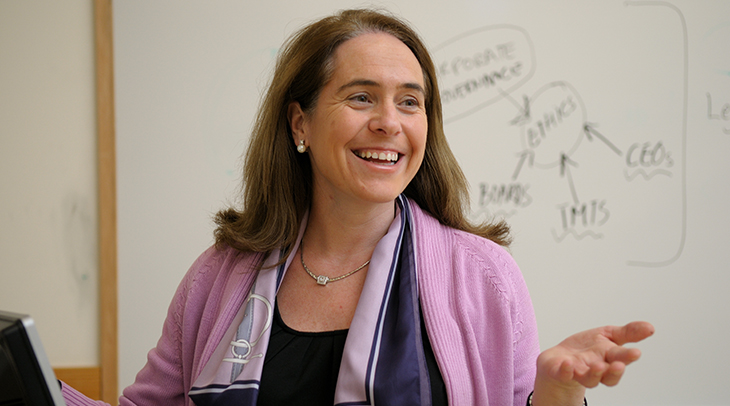
For Darla and Frederick Brodsky Trustee Professor in Global Business and Professor of International Business & Strategy Ruth V. Aguilera, the questions that shaped her career began with something she felt was missing.
Why do companies facing similar challenges organize themselves differently? Why does a governance model that works in one country look completely different somewhere else? And what happens when the institutions, values, and people surrounding a business change?
As an undergraduate studying economics and sociology at the Universitat de Barcelona in Spain, Aguilera grew increasingly frustrated with the discipline's reliance on assumptions and abstract models. “I was bothered that economics was everything about assuming, making assumptions,” she says. “They were really not taking the context into account.”
She wanted to understand what happens outside the models — how companies actually operate, how people behave, and how the environment surrounding a business shapes its decisions. “I wanted to study real things because it was all abstract. I wanted to study real firms, real people.”
That curiosity led her to pursue a PhD in sociology, specifically economic sociology, at Harvard University. It also became the foundation for a career focused on a question that continues to define her work: Why do companies facing similar challenges organize themselves so differently?

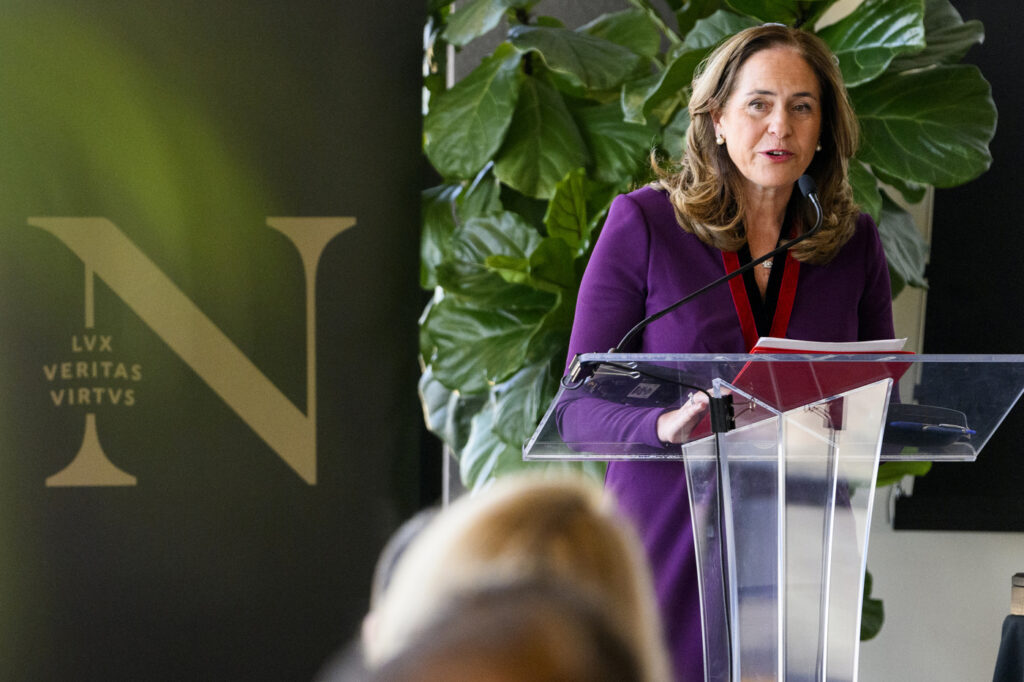

An unexpected path to research
As a young student, Aguilera took a research position, working alongside a professor and other researchers, which sparked an unexpected interest in academic research. She began publishing, received grants to study in Lancaster, England, and later spent time at the University of California, Berkeley, and the University of Michigan. By the time she was considering doctoral programs, research had become less of a job and more of a calling. At Harvard, Aguilera deepened her study of institutions, networks, and power structures. That foundation would eventually become central to her work in corporate governance.
Her training in sociology brought questions of power, institutions, and context into conversations about business. Corporate governance, she realized, offered a way to bring those ideas together.
“Having been an economist, there was little about power, authority, or context,” she says. “And corporate governance is very much about the distribution of power: who has the authority, who decides about the resources, when something goes wrong, who is accountable.
Challenging the idea of one “best” model
Aguilera's international background gave her another reason to question conventional assumptions about business. She grew up in Catalonia, studied in the United Kingdom and United States, and eventually built an academic career examining companies across countries and institutional systems. Her experience in Spain had exposed her to a different conception of ownership and corporate purpose. “My most-cited paper is about how there are different types of owners,” Aguilera says. “Take a grandmother who owns a vineyard — she just wants it to provide enough for the family. She has no interest in growing it. That kind of owner is very different from a private equity owner, a state owner, or a corporation with a million shareholders.”
Those differences became central to Aguilera's research on comparative corporate governance. Her foundational work with Gregory Jackson showed how governance systems vary across institutional domains, including capital, labor, and management—and why those differences persist rather than simply converging toward one model.
For Aguilera, the lesson is straightforward. “My number one mantra is there is not one rule that fits all,” she says. She offers another way to think about it: “There are different roads that lead to Rome.” Successful companies can take different paths depending on their owners, employees, industry, country, and time horizon.
“This is called configurational thinking,” she says. “There are multiple paths. Some paths might take longer.” That way of thinking also shapes how she teaches global strategy at D'Amore-McKim. “Thinking about the context is very important. What are the values of the society? And the norms, some informal norms and then the legal norms. You need to take the context into account. That's my number one thing.”

Governance is about more than creating value
After decades of studying corporate governance, Aguilera's view of the field has broadened beyond questions about boards and shareholders. At its core, she says, governance is about understanding power and accountability — and what happens to the value a company creates. “To make strategic decisions, it is very important to understand the distribution of power and authority within the corporations,” she says. “And that it is well designed.”
That design requires checks and balances that can help companies produce long-term value. But creating value is only part of the equation. “Another critical dimension of corporate governance is once the value is created, how do organizations distribute that value?” Aguilera says. “Do they give it back to the employees? Do they distribute it to the shareholders? Or do they reinvest it?”
That same emphasis on accountability applies to organizations of every size. “The one thing that all business should have, as a necessary condition, is to equip themselves with a web of accountability,” she says. For a large corporation, that might mean a board that supports, monitors, and advises the CEO. For a startup, it could be a small group of trusted professionals who periodically challenge the founder's decisions.
“All leaders should build a web of accountability around themselves,” she says. Without those checks and balances, she warns, “there is hubris, then there is greed, and then this is when things derail.”
The next board member could be AI
Today, Aguilera is applying the same questions about power, accountability, and institutional context to one of the biggest changes facing organizations: artificial intelligence.
Her emerging research agenda focuses on AI governance and how organizations can use AI productively, including inside boardrooms and classrooms. One idea particularly fascinates her: the possibility of an AI director participating in board discussions.
Rather than AI simply providing data or analysis behind the scenes, Aguilera envisions it as another participant in the conversation. The question is not simply what AI can do, but how it could improve the quality of human decision-making. Aguilera believes AI could help boards overcome what she calls “myopic bias.”
“Everybody agrees with the loudest voice, and you don't get to hear all the opinions,” she says. “And then you lose the richness of board diversity.” An AI director could listen across the conversation, identify perspectives that haven't been considered, and quickly run models or simulations to help directors explore different scenarios.
“I do think that this AI could take a lot of the bias out and say, okay, I'm hearing this, I'm hearing that, but I'm not hearing this director,” Aguilera says. She sees a similar possibility in the classroom, but the questions surrounding AI are just as important as the technology itself. If AI contributes materially to a board decision, who is accountable when something goes wrong? What kind of human oversight is necessary? How should organizations govern AI when rules and expectations differ across countries?
Those questions are now part of Aguilera's research agenda. Her recent work frames AI governance as an institutional challenge involving accountability, fiduciary responsibility, human oversight, and divergent regulatory systems. It's a natural next chapter for a scholar whose career has focused on how institutions shape business.
The context has changed. The question remains.
“Tell me who you work with, and I'll tell you who you are”
Despite the scholarly recognition Aguilera has received throughout her career, she points elsewhere when asked what has mattered most: people.
She describes research as a profession where rejection is common, and the work can be isolating. That has made collaboration particularly important to her. Her advice to students and young professionals reflects that experience. “It's great to be a professor, it's great to be a researcher because you are always learning and being curious,” she says. “But I think that's the obvious one.”
The less obvious lesson? “Surround yourself with good people,” Aguilera says. “Ethical people that you respect, that you trust, and that you enjoy working with.” She says she has been fortunate to develop a good instinct for choosing collaborators and stepping away from relationships that were not productive.
In Spain, she says, there is a saying: “Tell me who you walk with and I'll tell you who you are.” For Aguilera, the phrase captures something that's been true throughout her career. Ideas matter. Institutions matter. Research matters. But so do the people you choose to build with.
And perhaps that fits a scholar whose work has always asked us to look beyond the obvious—to question assumptions, understand context, and recognize that there is rarely only one path forward.