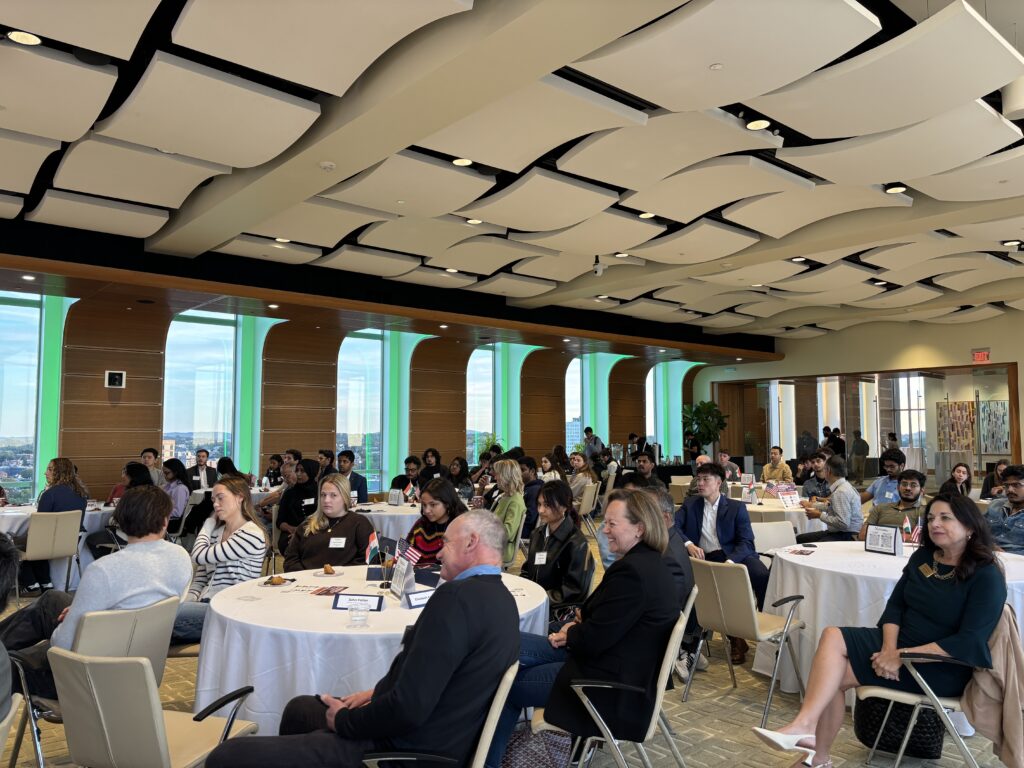
On October 2nd, over 100 students, faculty, and business leaders gathered at Northeastern's D'Amore-McKim School of Business for a conversation about the future of artificial intelligence and whether India can compete in this rapidly evolving technology sector. The evening's guest, Frank D'Souza (Pt '28), former CEO of Cognizant and current co-founder and Managing Partner of Recognize, believes the answer is yes, but India's competitive advantage will look different from America's or China's.
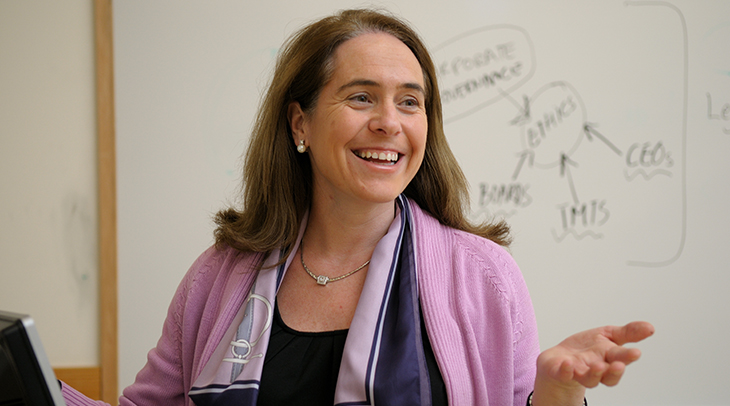
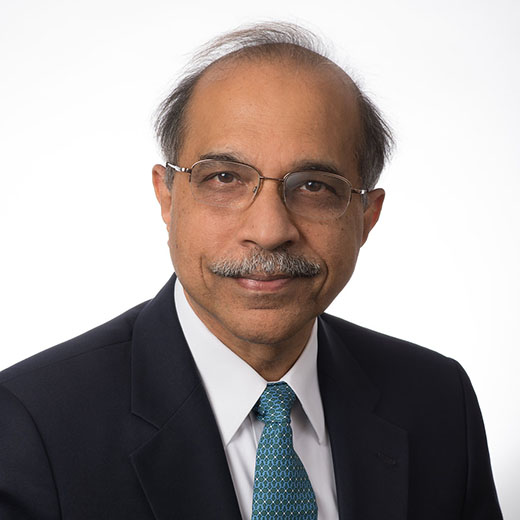
Deputy Dean Rajesh Aggarwal opened the evening by highlighting Northeastern's leadership in AI through the D'Amore-McKim Artificial Intelligence Strategic Hub and the integration of AI into classrooms, making the conversation particularly relevant to the university's strategic direction. The event, moderated by the Center for Emerging Markets' Founding Director, Ravi Ramamurti, then drew the audience into an engaging conversation with a Northeastern parent with unique insight into both India's past success and its uncertain future.
D'Souza's journey to technology leadership began unexpectedly in the 1980s, when his father, an Indian diplomat, came home with a New York Times article about personal computers and told his teenage son, ” I think it might be the future, you should learn more about it.” That curiosity led D'Souza to Carnegie Mellon for an MBA focusing on information systems, then to Dun & Bradstreet, where he was sent to India to establish a development center. What started as an internal project became Cognizant, which D'Souza grew over 26 years into a Fortune 200 company with 300,000 employees.
When asked what made Cognizant successful against established competitors, D'Souza emphasized two factors: culture and credibility. “Culture really was our competitive advantage,” he explained. The company built a team focused on continuous adaptation. “If you come into work one morning and you're doing something the same way you did it yesterday, you're already on your path to obsolescence.” That culture, combined with delivering on quarterly promises to investors, created the trust needed to thrive.
D'Souza drew parallels between today's tech environment and the 1990s, when low-cost bandwidth enabled offshoring and disrupted the entire services industry. “AI is going to disrupt the services industry like offshoring did back in the 1990s,” he told the audience. The innovator's dilemma makes it difficult for incumbents to transform, even when they see disruption coming. Looking back at the 1990s, “very few of the firms that existed then still exist today.” He expects similar creative destruction ahead for firms in India and elsewhere, though he's optimistic that successful adaptation and innovation will happen globally.
On whether Indian companies can legitimately compete beyond building “wrappers” around AI models, D'Souza reframed the question entirely. India lacks the capital to build infrastructure at U.S. scale but has comparative advantages in talent and potentially in data, given its massive digitally enabled population. “India's opportunity is at the inference level, at the top of the stack,” he argued. “That's where domain expertise is particularly important.” The U.S. will likely continue leading in infrastructure, China is getting competitive in building models, and India can carve out its niche in application and implementation.
For emerging economies beyond India, D'Souza emphasized that the biggest opportunity isn't necessarily building foundation models but applying AI across traditional sectors to boost productivity, potentially lifting GDP by 35-40% in countries that create forward-thinking policies.
The question of AI's impact on the job market loomed large. D'Souza acknowledged that both India's 6 million IT workers and 6-10 million BPO employees face disruption, but he sees reason for optimism. Just as the internet created entirely new job categories, like data labeling or coding roles, AI will generate new categories of work. “When we sit here 10 or 20 years from now, we will almost certainly say that the world is more technology-intensive than it is today,” he explained. “That effort is going to require humans and it's going to require new categories of jobs.” Students today will need to fundamentally reinvent themselves two or three times during their careers, drawing on adaptability and embracing lifelong learning to thrive.
D'Souza's answer to the evening's central question was ultimately optimistic but conditional. India can compete, but not by replicating what the U.S. and China are doing. Success will require playing to India's strengths in talent and domain expertise, building adaptable cultures, and moving fast enough to avoid the fate of incumbents from previous technological revolutions. The firms and individuals who embrace continuous change, D'Souza suggested, will find their place in this new landscape.
This event was a part of the Vivek and Vandana Sharma India Initiative, supporting programming to expand and deepen Northeastern University's engagement with economic and business issues in India.